
Nowadays, bilberries have received considerable interest as a functional food or nutraceuticals for health improvement. These berries contain biologically active compounds – anthocyanins, known as natural antioxidants, which are able to bind free radicals in the human body and inhibit the ageing processes. In addition, research confirmed that anthocyanins are effective in improving vision, treating cardiovascular diseases, cancer and diabetes [1]. However, the main disadvantage of anthocyanins is their instability due to various external factors such as pH, light, temperature and etc. [2].
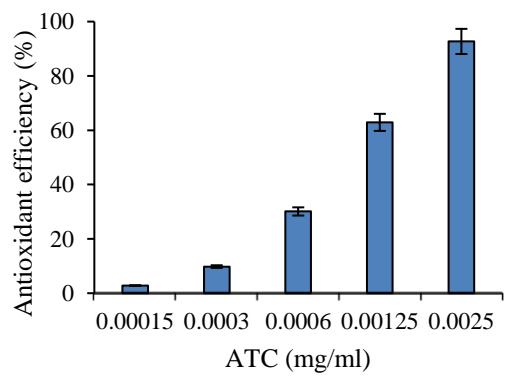
The aim of this study was to study the encapsulation of Vaccinium Myrtillus L. anthocyanins (ATC) into liposomes formulated from soy lecithin. First of all, the antioxidant activity of anthocyanins (ATC) from bilberry extract was determined by using ABTS (2,2'-azino-bis(3-ethylbenzothiazoline-6-sulfonic acid) method. The antioxidant efficiency of ATC varied from 2.8 to 92.7 % depending on the concentration of active compounds in the reaction mixture (see Fig. 1). In addition, the stability of ATC was evaluated by storing the samples for up to 28 days at different temperatures. It was found that the antioxidant efficiency of ATC decreased from 93 % to 60 % and 55 % when the samples were kept at 5 °C and 20 °C, respectively.
ATC from Vaccinium Myrtillus L. were encapsulated into liposomes from soy lecithin (LE). Six formulations containing various amounts of anthocyanins and lecithin were prepared in water or acetate buffer (pH=3.5) medium by using high shear homogenizer (see Table 1).
| Sample | Composition (%) | Medium | Particle size (nm) | PI | ζ-potential (mV) | pH | |
|---|---|---|---|---|---|---|---|
| LE | ATC | ||||||
| 1-LE-ATC | 5.0 | 0.06 | Distilled water | 205 ± 2 | 0.287 | -68.42 | 5.83 |
| 2-LE-ATC | Acetate buffer solution | 128 ± 2 | 0.250 | -55.75 | 4.16 | ||
| 3-LE-ATC | 2.5 | 0.09 | Distilled water | 271 ± 8 | 0.291 | -66.44 | 5.43 |
| 4-LE-ATC | Acetate buffer solution | 160 ± 4 | 0.259 | -52.30 | 4.19 | ||
| 5-LE-ATC | 1.0 | 0.11 | Distilled water | 217 ± 1 | 0.282 | -64.27 | 5.00 |
| 6-LE-ATC | Acetate buffer solution | 200 ± 7 | 0.297 | -37.02 | 4.26 | ||
It was revealed that smaller particles were formed when acetate buffer solution was used as a medium. In this case, the particle size varied from 128 to 200 nm depending on lecithin and anthocyanin amount in the formulation. When distilled water was used in the system the liposomes with particle size varying from 205 to 271 nm were obtained. The polydispersity index (PI) of all samples was lower than 0.3 indicating that those systems were quite homogenous and had particle size distribution within a narrow range. Measurements of the zeta potential showed that all formulations exhibited high negative surface charge, indicating that all liposomal systems were relatively stable.