
Chiroptical spectroscopy techniques are becoming more and more popular due to their wide application in the study of structure of chiral compounds as well as supramolecular systems. They can detect even small changes that are impossible to observe using conventional spectroscopic methods. Chiroptical spectroscopies include Electronic Circular Dichroism (ECD), Raman Optical Activity (ROA), Vibrational Circular Dichroism (VCD) and Circularly Polarized Luminescence (CPL). [1]
In our research ECD and ROA were used as well as their non-chiroptical analogues, UV-Vis Spectroscopy and Raman Spectroscopy. Electronic Circular Dichroism measures a difference between left and right circularly polarized absorbed light due to chiral compounds. It is a very sensitive tool that provides rich information about the ground electronic state of molecules. Raman Optical Activity is based on inelastic scattering of light. It measures a difference between right and left circularly polarized Raman scattered light due to chiral compounds. It is much less sensitive than ECD, therefore it is necessary to prepare very well purified samples in high concentrations and do measurements with high laser power and long time of spectrum accumulation. [2]
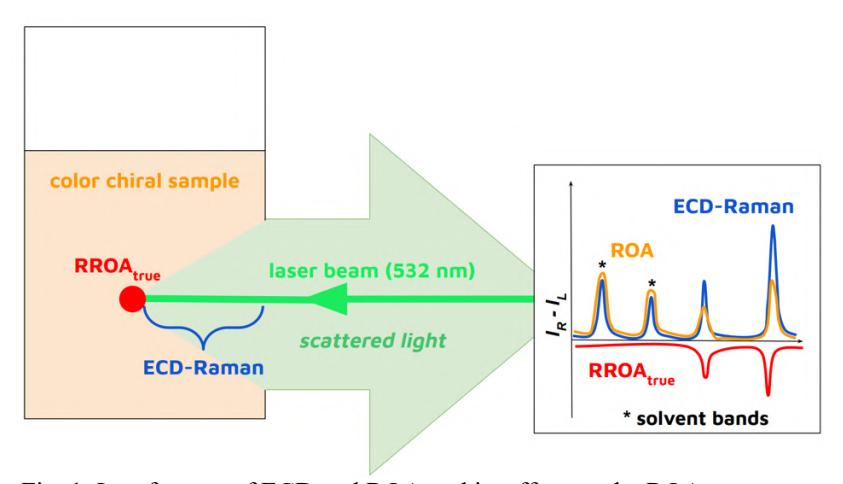
Recently, a new phenomenon of interference of Electronic Circular Dichroism and Raman Optical Activity was discovered. It is known as ECD-Raman effect and occurs for chiral samples that absorb laser light and have an ECD band in the wavelength range of the laser line used in ROA measurements (in our research it was 532 nm). As shown in Figure 1, the ECD-Raman effect is related to the polarization of the laser beam after passing through the chiral sample, and then additional polarization of the scattered light. [1,3] The effect is possible to observe at ROA spectra because it is enriched with an additional, sometimes dominant, component for both the achiral solvent and chiral solute bands. Recognition of ECD-Raman effect and its minimization is important for the correct interpretation of the ROA spectra and appropriate concluding about the molecular structure of measured compounds.
In our research we carried out the spectroscopic analysis of chiral naphthalene diimide derivatives [4] dissolved in achiral organic solvents (i.e., chloroform, CHCl3 and dimethylsulfoxide, DMSO). For each of the compounds, the vibrational spectra were dominated by achiral solvent bands and chiral solute bands was barely seen. The sign of the ROA spectra was complied with the sign of ECD band in range of the excitation laser line. These observations proved the ECD-Raman effect occurrence.
This work was supported by National Science Centre in Poland (Grant No. 2020/39/B/ST4/01670 and Grant No. 2019/33/N/ST4/01986).