
Shape memory polymers have a unique ability to obtain temporary shapes and return to their permanent shape in response to stimuli. This unique ability greatly increased the area of application of such polymers [1]. Dual curing is one of the possible ways to obtain shape memory materials. It allows us to create materials with unique properties by combining two different polymerization reactions [2].
In this study, cross-linked polymers were obtained by dual curing of vanillin diacrylate, vanillin dimethacrylate and vanillin hydroxypropane dimethacrylate with 1 or 0.5 mol.% of 1.3-benzenedithiol, using ethyl(2,4,6-trimethylbenzoyl)phenylphosphinate as photoinitiator. Two different reactions, free-radical and thiol-acrylate photopolymerisation, were tuned by varying the ratio of thiol to acrylate.Photorheometry was used to monitor the evolution of the photocross-linking process. The UV/Vis real-time photorheometry curing tests were performed on a MCR302 rheometer from Anton Paar equipped with the plate/plate measuring system. It was determined that the increase in the amount of thiol in the resins reduced the photocuring rate and the rigidity of the resulting polymers.
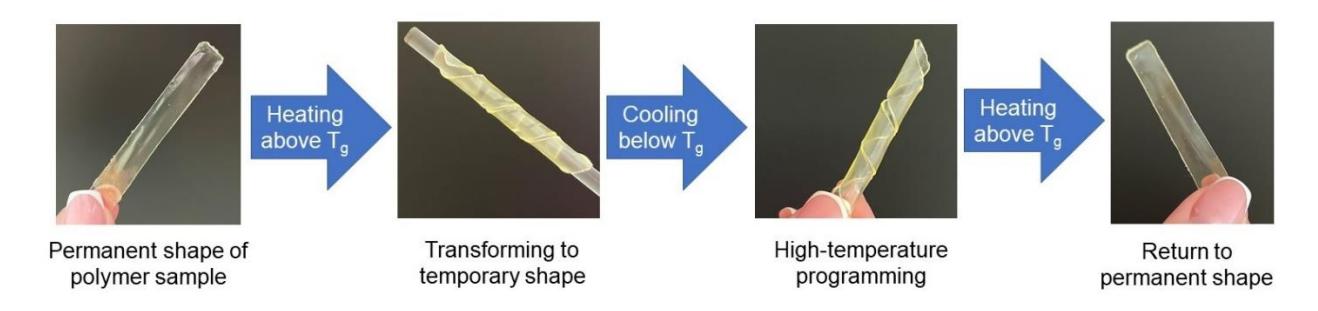
To show shape memory properties of vanillin-based polymers, we heated the polymer samples above their glass transition temperature (Tg) and then deformed them to the desired temporary shape. The glass stick was used to form polymer samples. When the temporary shape was obtained, it was fixed by cooling the polymer sample below its Tg. Polymer samples were able to maintain their temporary shape in the temperature below their Tg. All polymer samples were able to return to their permanent shape in a short period of time after heating above their Tg. The scheme of heating-cooling-heating cycles is presented in Fig. 1.
The tensile test was performed to investigate the mechanical properties of vanillin-based polymers. The reduction in thiol content was determined to improve the mechanical performance of polymers as Young's modulus increased from 1.4 - 3.5 MPa to 3952.3 – 11339.4 MPa [3].