
The Shockley–Queisser (SQ) limit determines the maximum theoretically possible efficiency of a single junction solar cell [1]. Under normal conditions, this limit is about 30% for conventional solar cells. According to the SQ theory, only photons with energy equal or higher than the band gap of the semiconductor can participate in the formation of an electron-hole pair. Photons with energy less than the band gap do not contribute to the photoresponse of the solar cells at all. The theory can be applied for the solar cells under illumination of one Sun with an AM 1.5G (1000 W/m²) spectrum standard.
We propose an idea that the photons with energies less than the semiconductor band gap as well as those of large energy should be accounted via the hot carrier phenomenon (Fig.1) before the thermalisation process.
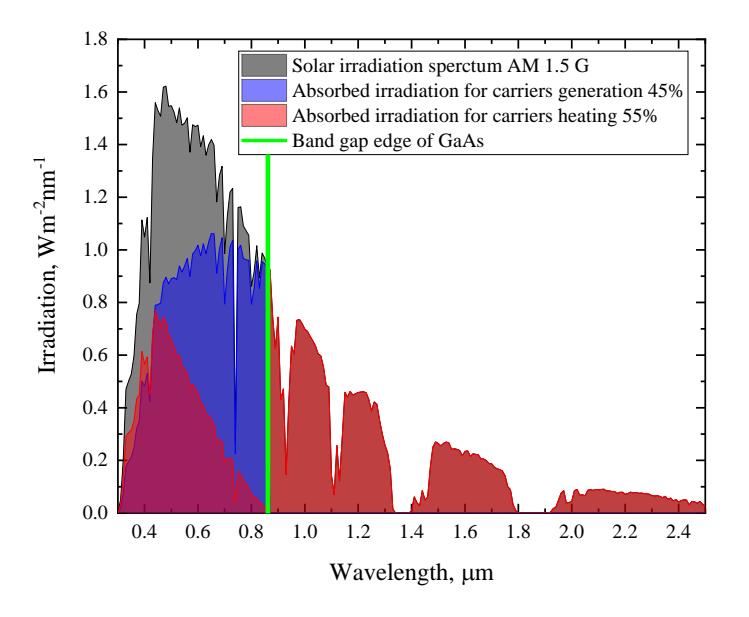
The object of investigation was GaAs p-n junction as known for its relatively expressed two-photon absorption [2]. The sample was illuminated by a laser light with wavelength 1.06 μm, pulse duration 25 ns, and maximum intensity 10 MW/cm2. The laser photon energy is less than the bang gap of GaAs, 1.16 eV and 1.42 eV respectively. In this case, the process of electron-hole pair generation occurs only though two-photon absorption, and carrier heating process happens due to the intraband absorption.
Additionally, we provide a model describing a solar cell's photoresponse signal via three its components initiated by generation, lattice heating and hot carrier phenomena. The model is based on the assumption that the p-n-junction is a first-order linear time-invariant system. The finding opens the way to estimate conditions determining contribution of each component into the net photovoltage [3].
As for application, the negative effect of hot carriers should be reduced to boost the efficiency of solar cells. This can be achieved by way of harvesting the energy of hot carriers before they cool or by developing solar cell structures preventing free carrier heating.