Photonic crystal fibers (PCFs) are a unique type of optical fibers, completely different from conventional optical fibers, due to their periodic microstructure geometry of air holes running along the entire length of the PCF and surrounding the fiber's solid core. The engineering ability to alter various geometry parameters (air hole size and position) enabled various unique features that are not accessible for a common optical fiber. Due to their exceptional properties, solid-core PCFs are considered to be a perfect nonlinear medium for enhancing nonlinear effects, related to the third order nonlinear susceptibility χ(3) or nonlinear refractive index n2. Processes related with nonlinear refractive index, also known as optical Kerr effect, are self-phase modulation (SPM), cross-phase modulation (XPM), four-wave mixing (FWM) and even stimulated Raman scattering. Combined nonlinear processes can lead to different temporal and spatial pulse modulations, e. g., supercontinuum generation [1-4]. Therefore, it is necessary to properly evaluate the fiber's nonlinear refractive index and its dispersion. Although traditional nonlinear refractive index measurements methods, such as Z-scan, are practical and simple for bulk medium, this method is unsuitable when dealing with fibers, due to the waveguiding effect. Other methods based on FWM, or other nonlinear processes are also not applicable when ultrashort femtosecond pulses are used [5-6].
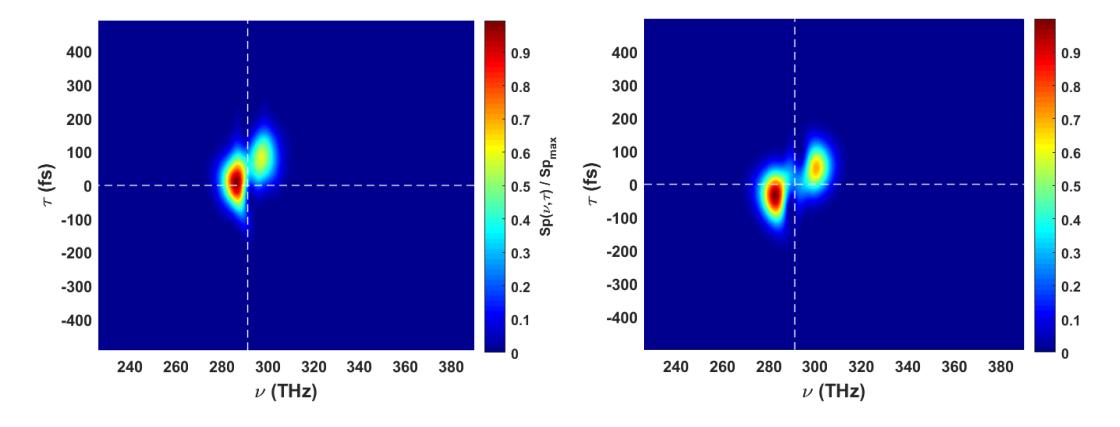
In this work we present a new method to measure nonlinear refractive index in optical fibers. It combines cross-correlation frequency-resolved optical gating (XFROG) measurement of controlled chirp femtosecond pulse spectrum broadening inside PCF together with theoretical modeling to determine the photonic crystal fiber's nonlinear refractive index and its dispersion values. Photonic crystal fiber nonlinear refractive index measurement was performed using Yb:KGW "Flint" oscillator generating 110 fs duration pulses with 75.2 MHz repetition rate and with a central wavelength of 1028 nm. A transform-limited pulse was obtained by evaluating and compensating pulse chirp values after passing all optical elements and additionally considering the dispersion caused by the focusing microscope objective. Pulse broadening measurements were performed by implementing XFROG technique and XFROG traces were measured at different pump power values. Then numerical simulations of pulse broadening at different pump power values were performed. The result is obtained (correct nonlinear refractive index value determined), when numerical simulation and experiment results are in good agreement.
Comparison between measured results and theorical modeling (Fig. 1) allowed to determine the nonlinear refractive index of a polarization maintaining SC-5.0-1040-PM photonic crystal fiber (mode field diameter is 4.3 μm ± 0.2 μm and ZDW is at 1040 nm ± 15 nm), which was equal to 1.8 10-20 m2/W and its dispersion n2' = 6.5 10-20 m2 fs/W. Furthermore, this approach also allowed to evaluate another important parameter describing the pulse propagation in PCF: pulse intensity modulation nonlinear coefficient, which in our case was equal to Δ n2' = -1.3 10-19 m2 fs/W.