
Organosilicon and organogermanium compounds are rather attractive in the field of surface science. Cyclic hydrocarbon films have good surface adhesion properties which are mostly related to a ${\pi}$ electron orbitals1. Substituting one carbon atom in the ring with a silicon or germanium enhances adhesion since it acts as hydrolytically sensitive center that can react with inorganic substrates such as glass to form stable covalent bonds2. 1-methyl-germacyclohexane is a newly synthesized cyclic organic compound with unknown structural parameters and conformational diversity.
Various methods of vibrational spectroscopy were employed to analyze the properties of this molecule. Infrared and Raman spectra were recorded for the liquid samples. Additionally, IR absorption spectra were registered in gas phase. DFT calculations were performed utilizing B3LYP functional and augmented Dunning correlation-consistent valence double zeta basis set. The calculations reveal that 1-methyl-germacyclohexane has two stable conformations out of which the axial conformation has the lowest energy.
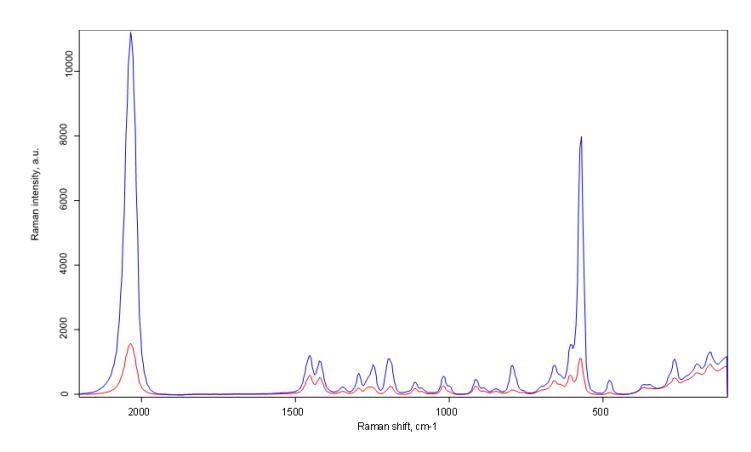
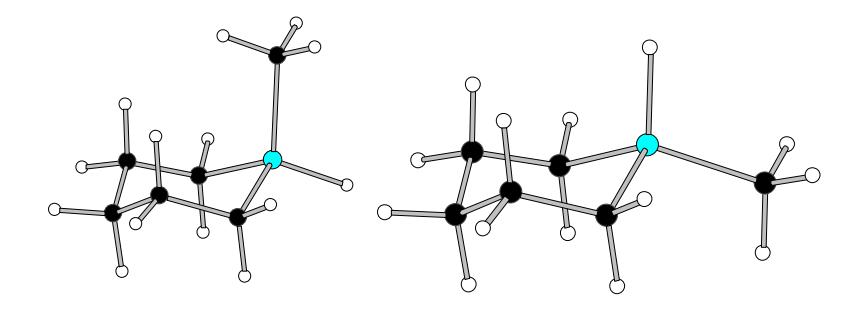
According to the calculations, both conformers - axial and equatorial (see fig.1) differ in potential energy just by ${\Delta}E = 1.4 \text{ kJ/mol}$. Calculations show that most of the vibrational spectral bands overlap. Experimental Raman spectra (see fig. 2) of horizontal and vertical polarizations confirmed our assignment of non-overlapped Raman bands of both conformers. The band of equatorial conformer at 693 cm-1 is assigned as out of plane C-Ge-C deformation, while the band of axial conformer at 632 cm-1 is assigned to Ge-C stretching vibration. Experiments will be continued using matrix isolation FTIR spectroscopy, which should result in narrow spectral bands with better separation of the bands arising from both conformers.