
Precious metals gold and silver nanoparticles have become the focus of nanotechnology due to the wide absorption band in the electromagnetic spectrum. They have a high area-to-volume ratio, electrical conductivity, chemical stability, catalytic functions and good biocompatibility [1, 2]. The optical properties of metal nanoparticles depend on the localized surface plasmon resonance (LSPR). LSPR is the frequency caused by conductive electron oscillations generated by the interaction with an electromagnetic wave [3]. This quantum phenomenon can be manipulated by altering the size, dispersion, shape, composition, and other physical and chemical characteristics of nanoparticles [4]. To do this, different synthesis methods and parameters are used, which determine the morphology, stability and physicochemical properties.
Nanoparticles generated by laser ablation in water from bulk material tend to aggregate. To avoid aggregation, a method was tested by synthesizing nanoparticles from thin coatings on a glass substrate in water and KCl salt solution. Salt was introduced into the experiment as an additional stabilizer.
The absorption of gold and silver nanoparticles occurs in different areas of the visible electromagnetic spectrum. Hybrid gold-silver and silver-gold nanoparticles are used to extend the resonant wavelength range. The scheme for the synthesis of hybrid nanoparticles is shown in Figure 1 (a). The target is immersed in the selected solution and exposed to a laser. In one laser scan, the entire glass substrate is cleaned and the coating is broken down into fragments - nanoparticles that spread through the liquid and form a colloidal solution. A TEM image of the hybrid nanoparticles is shown in Figure 1 (b).
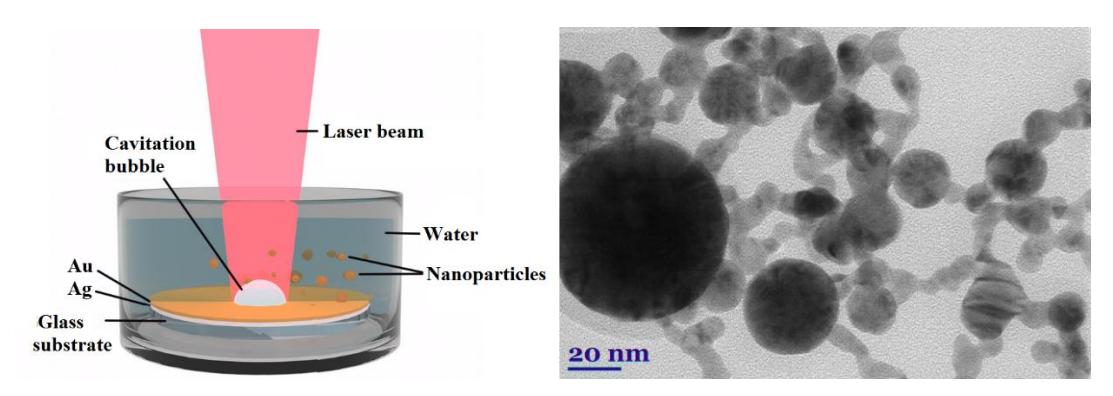
A method for generating hybrid gold-silver nanoparticles from thin coatings on glass substrate in a liquid by nanosecond laser ablation and investigation of the plasmonic properties and stability of the formed particles will be presented.