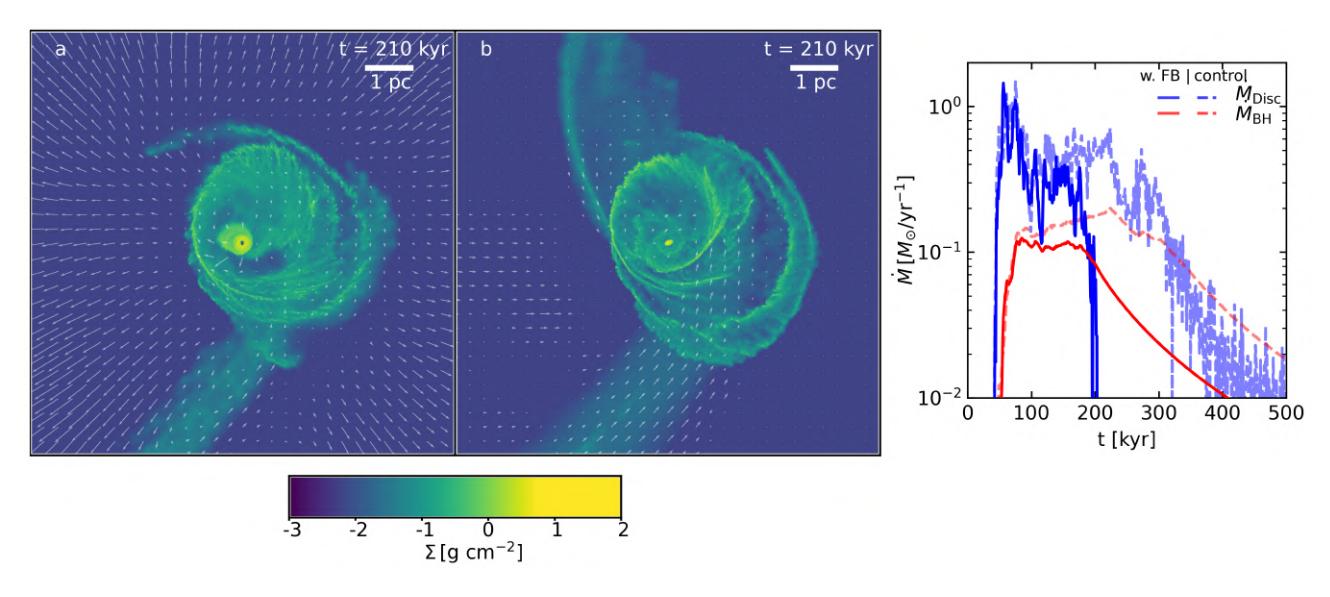
The large galactic scales seem to be connected to the many orders of magnitude smaller supermassive black hole (SMBH) scales by an episodic cycle of feeding and feedback [1]. The connection and possible interaction between the infalling/outflowing ISM makes it important to correctly address the timescales involved in SMBH feedback, but the large difference in relevant spatial scales makes the problem difficult to model directly.
One of the ways to address this issue in hydrodynamical simulations is to implement a “two-stage" sub-grid pre-scription for SMBH accretion. Matter swallowed by the SMBH particle is added to a separate reservoir coupled to the SMBH instead of directly feeding the black hole [2]. This allows one to delay the accretion and feedback by an arbitrary amount, changed by setting the timescale of reservoir depletion.
We extend the usual two-stage model to include a simple $\alpha$-accretion disc model [3] coupled to the SMBH sink par-ticle. The disc is evolved viscously with a separate timestep criterion from the simulation as a whole, but is synchronized at SMBH timesteps. Feedback is directly determined by the accretion disc, with radiation efficiency naturally approaching $\eta \approx 0.0625$ [4]. This allows us to determine the accretion timescale self-consistently and investigate the effects of gas accretion on the surrounding matter reservoir in a physical manner.
We test our approach by running a set of simulations of a several-parsec-wide region with conditions similar to those at the centre of our Galaxy using the 3D hydrodynamical code Gadget-3 [5]. Each model consists of four main components: the central SMBH ($M_{\rm bh} = 4 \times 10^6 \, M_{\odot}$), the Circumnuclear Disc-like toroidal gas ring ($M_{\rm r} = 10^5 \, M_{\odot}$, $R_{\rm in} = 1.5\,{\rm pc}$, $R_{\rm out} = 4\,{\rm pc}$), an infalling molecular cloud ($M_{\rm mc} = 10^5 \, M_{\odot}$, $R_{\rm mc} = 3\,{\rm pc}$) and diffuse background gas ($M_{\rm bg} \approx 1.2 \times 10^3\,M_{\odot}$); $R_{\rm bg} = 25\,{\rm pc}$). A retrograde collision between the molecular cloud and the gas ring results in significant accretion, where the accretion disc is fed by the gas that crosses a sink boundary ($r_{\rm sink} = 0.01\,{\rm pc}$) in the hydrodynamical model. We show that feedback has a significant effect in regulating the growth of the SMBH (Fig. 1). The growth rate of the SMBH, $\dot{M}_{\rm BH}$, is reduced and spread more evenly over time as compared with the instantaneous accretion prescription. A significant amount of matter escapes via the outer boundary and may lead to star formation in the central parsec.