
With the ever increasing demand of clean and renewable energy, hydrogen gas, which could be produced via catalytic water splitting, has been attracting great interest in recent years. Currently, platinum and its alloys are best performing electrocatalysts, although their practical usage is hindered by the scarcity and cost of Pt noble metal [1]. Therefore, cheaper alternatives are sought after and two dimensional layered materials, such as molybdenum disulfide, are showing promising hydrogen evolution reaction activity, thus garnering the attention of researchers [2].
In this study, we report the effect of histidine amino acid for the synthesis of more efficient and stable MoS2-based catalyst, fabricated via hydrothermal processing directly onto the conductive Ti/TiO2 substrate. From the SEM images (Fig.1a,b), the thickness of TiO2 film was approximately 0.56 μm, and the thickness of nanoplatelet-shaped MoS2 film varied from 0.9 to 1.2 μm. The catalytic activity of fabricated electrocatalysts was investigated by cyclic voltammetry in 0.5 M H2SO4 solution using a three-electrode setup. From the cyclic voltammograms (Fig. 1c) it can be seen that MoS2-his films are initially more active in comparison with MoS2 films without histidine, displaying insignificant current density decrease after 1000 potential cycles, indicating high working stability during prolonged hydrogen evolution reaction processing.
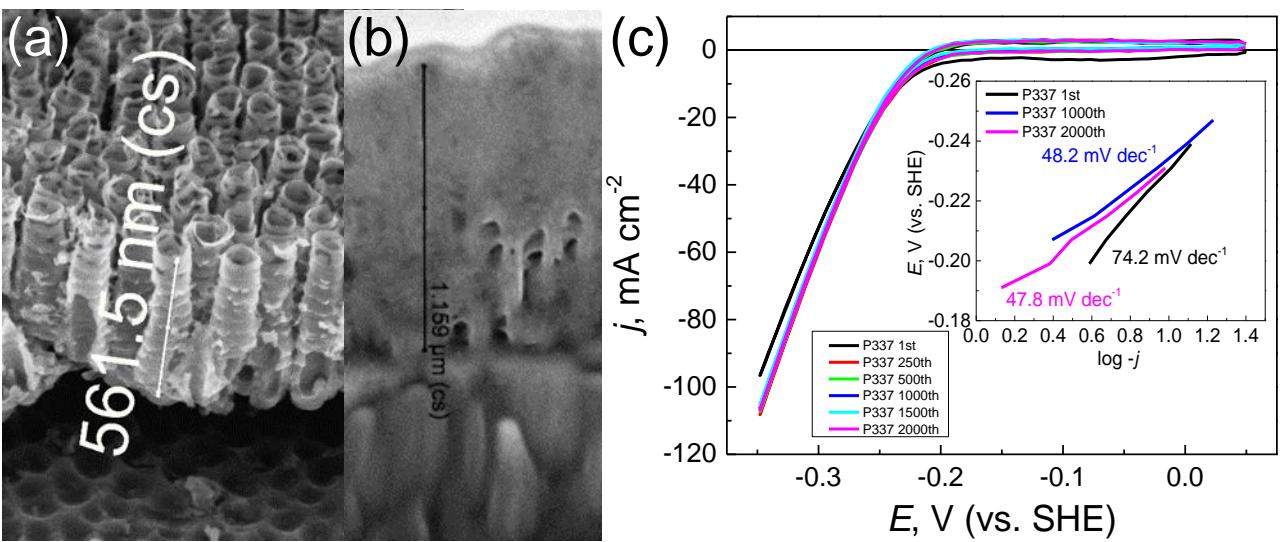
Tafel slopes (Fig. 1c. Inset) were found to be around 48 mV/dec after 2000 potential cycles, confirming the activity and stability of fabricated electrocatalysts during prolonged hydrogen evolution reaction processing. We demonstrated that increased stability of MoS2-his hybrid electrocatalyst could be attributed to the formation of 1T-MoS2 and 2H-MoS2 mixture during the hydrothermal synthesis. Further research into the influence of amino acids on MoS2 electrocatalyst synthesis should provide a better understanding of the conditions needed to fabricate efficient MoS2-based electrocatalysts.