Fluorescent molecular probes are very useful for studying live cells and various organelles because they can indicate changes in environmental properties [1]. One of these properties—microviscosity—can be detected with viscosity-sensitive fluorophores called 'molecular rotors'. The mechanism of these derivatives is based on the competition between intramolecular rotation and fluorescence, which can be registered by time-resolved fluorescence spectroscopy. Molecular rotation alters the electronically excited state and causes a faster non-radiative relaxation, which consequently determines a longer fluorescence lifetime in a highly viscous medium [2].
Many microviscosity probes are based on dipyrrometheneboron difluoride, commonly known as BODIPY. One of such molecular rotors is BODIPY-C10, an excellent lifetime-based microviscosity sensor exceptional for data-simplifying monoexponential fluorescence decay. However, green absorbance and fluorescence spectra make BODIPY-C10 imperfect to use for microviscosity imaging in biological samples where light scattering is an issue. The extension of molecular conjugation length is a simple solution to red-shift absorbance and emission spectra. It should also be considered that a single BODIPY conjugate can be sensitive to all three environmental parameters: microviscosity, temperature and polarity. Recently, we investigated BODIPYs with extended molecular conjugation [3] and decided to explore how the sensory properties of these derivatives can be tuned by introducing different moieties.
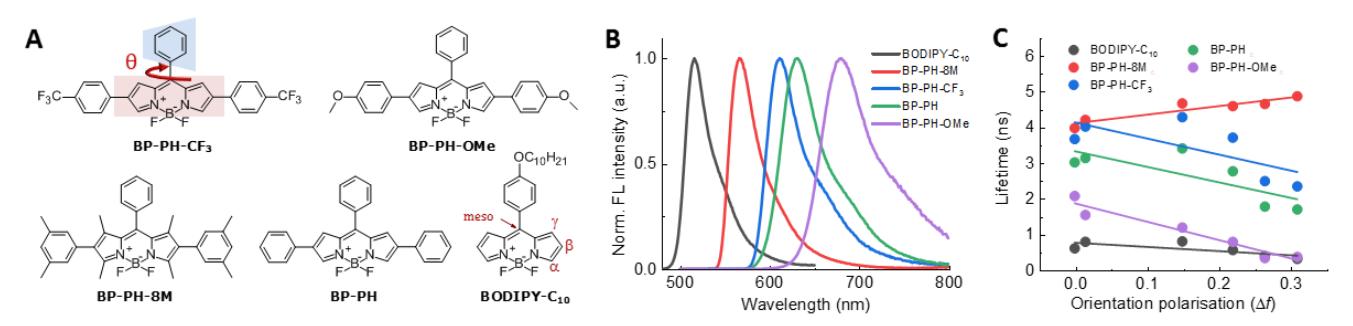
To find out how electron-donating/withdrawing groups (EDG/EWG) can affect molecular rotor's properties of sensing viscosity, temperature and polarity, we compare the most popular green-fluorescent BODIPY-C10 and four β-phenyl-substituted BODIPYs (Fig. 1A): BP-PH as a red-emitting reference, methyl-substituted BP-PH-8M with suppressed rotation, as well as trifluoromethyl-substituted BP-PH-CF3 and methoxy-substituted BP-PH-OMe to evaluate the effects of EWG and EDG, respectively. All β-phenyl-substituted conjugates, except BP-PH-8M, have an increased conjugation of the molecule, which helps to achieve the red spectral region required for the biological samples.
In this work [4], we present investigation of quantum chemical calculations, absorbance and fluorescence spectra, time-resolved fluorescence measurements and sensitivity to viscosity, temperature and polarity. DFT calculations showed that BP-PH-8M has the highest activation energy barrier (almost 0.3 eV) because the methyl groups prevent molecular rotation. In contrast, the other conjugates have twice as low barrier, resulting in faster non-radiative relaxation. Steady-state fluorescence measurements revealed that EWG blue-shifts the fluorescence spectrum, while EDG shifts it to the longer wavelengths (Fig. 1B). Finally, fluorescence decay kinetics demonstrated that BP-PH-CF3 is a moderate temperature sensor, while BP-PH-OMe could be used as a lifetime-based polarity probe (Fig. 1C).