
The production of plastic virgin materials is growing and has now reached 367 million tons per year and it will create more and more waste each year. The dominated plastic is the thermoplastic types of polypropylene (PP) (21%) and low-and linear low-density polyethylene (LDPE and LLDPE) (18%) [1]. The problem of increasing waste streams will only grow. The leading position in post-consumer waste is occupied by packaging. There are more than 40% of packaging waste, which is much higher than other types of waste in Europe. 29.5 million tons of post-consumer waste were collected [2].
Mechanical recycling is the most common and economical method available for recycling post-consumer plastic waste and involves sorting, grinding, washing, and extrusion of the material [3] but still, a lot of materials go to the landfills. With mechanical recycling possible to obtain new products from plastic waste, for example, replacing wood or concrete products, thereby reducing the percentage of plastic waste and at the same time reducing CO2 emissions.
Post-consumer waste often ends up on production lines with large capacities for further granulation. For efficient and continuous granulation of this material, the most common extruder is used with a laser filtration system for deep cleaning of contaminants (wood, aluminum, copper, PA, etc.). In such cases, a "by-product" is formed from self-cleaning filters, the base of which consists of polyolefins but contains a large number of contaminants. The volumes of this raw material average 1% per ton of finished granulate. The material forms lumps from the filters, which can be crushed into a smaller fraction for easier processing material.
It is necessary to achieve stability in properties starting from the melt flow index (MFI) for the production of quality products from filtered material with impurities. Despite the fact that MFI is an empirically defined parameter with certain limitations, it is still one of the most popular parameters in the plastics industry for distinguishing various grades of polymers [4].
The basic raw materials from post-consumer packaging include LDPE, LLDPE, MDPE, HDPE, PP fractions with more than 10% contamination. Due to a large amount of visible contamination, the material was processed on a granulation line with a 300 μm filter mesh. The temperature was selected in accordance with the fact that the material heats up gradually as it moves along the cylinder from the first to the last zone and does not undergo destruction.
The obtained granule was suitable for carrying out the MFI test. To obtain an average melt flow index, 25 tests were made from the selected sample. Test conditions were chosen with temperature – 190 °C; load – 5 kg. The results of the MFI test are shown in Figure 1.
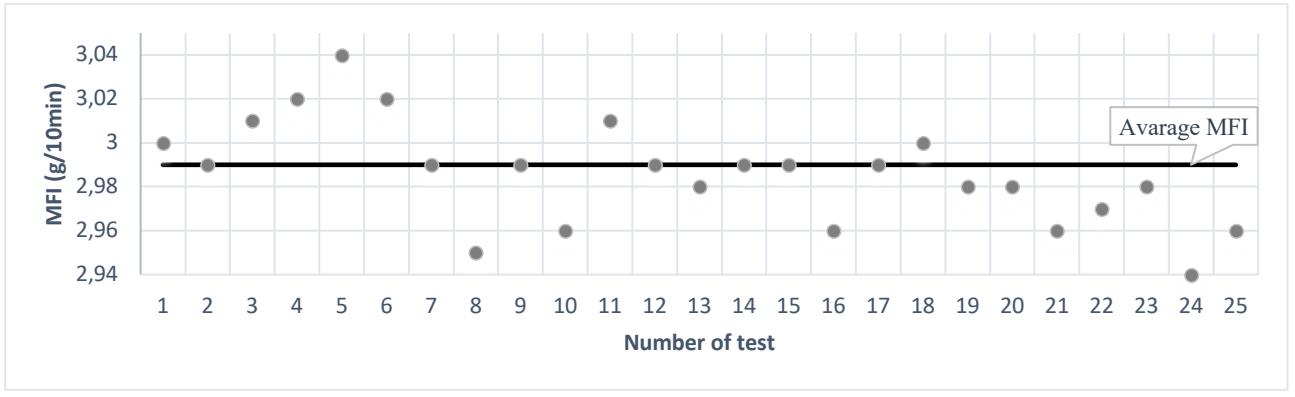
The average value of the melt flow index is 2.99 g/10 min. Small deviations from the average MFI indicate that the homogenization of the polymer was successful and this material can be used for further testing to confirm the possibility of using this raw material in the manufacture of various products. Using this raw material, we can reduce the amount of burning and disposal of polymer waste.