MRI is a non-invasive diagnostic tool for soft tissues that uses the magnetic properties of the 1H nucleus. It is one of the most widely used imaging procedures in medicine. It offers excellent spatial resolution, unlimited penetration depth and provides knowledge that cannot be accessed by other means. In order to improve the quality of the images 19F MRI is extensively investigated as a complementary modality allowing so called hot spot imaging. Since 19F atoms are not present in soft tissues, the modality allows for accurate representation of the targeted organ without background signals but require the introduction of an appropriate contrast agent containing 19F nuclei into the organism.
Regarding the 19F NMR or MRI as an aid in pH measurements several molecular probes were developed. The oldest reports concerned fluorinated aniline derivatives. The mechanism of action was based on protonation of aniline nitrogen, which changed the chemical shift of the fluorine. Other concepts utilized PEGylated nanogels containing perfluorocarbons, C6F6 loaded Au-fluorescent mesoporous silica nanoparticles, or copolymers. In those cases the mechanism of pH-depended signal changes was either based on the reversible volume phase transition of the nanogel structure, which releases the 19F NMR signal, or the irreversible decomposition of the capsule under the influence of pH and the release of fluoroorganic groups respectively. In each case single 19F signal of pH-dependent chemical shift was observed. More convenient for diagnostic purposes would be a probe displaying two separate signals of pH-dependent integrals ratio allowing internal reference and ratiometric measurements.
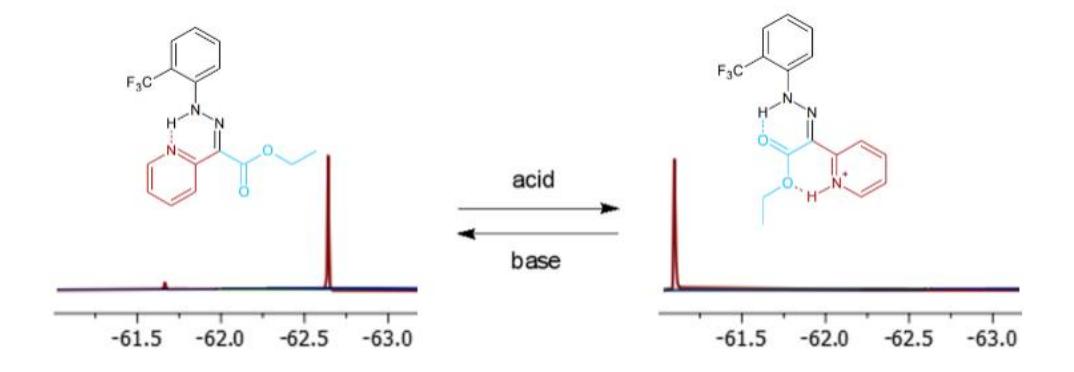
It occurred to us that in such role hydrazone-based molecular switches could be used. Molecular switches are usually defined as molecules that can reversibly transform between two (or more) thermodynamically stable states. It is a class of compounds sensitive to an external stimuli such as light, pH, or electric current and include classes like photochromic switches, host-guest switches, and rotaxanes. Here, we demonstrated for the first time the possibility of applying ratiometric reversible hydrazone-based molecular switches as 19F NMR/MRI pH-responsive compounds that use chemical shift changes.