
The fundamental structure of modern computers and information storage technologies will be aided by the development of materials showing strongly coupled magnetic and electronic properties. This technology of spin-based electronics can show the way to a new generation of electronic devices with spin-dependent effects that arise from the quantum magnetic interactions in molecular level [1]. On the one hand, characterization and modelling of the magnetic properties of molecular-based compounds are a major challenge for these technologies. On the other hand, supramolecular chemistry can solve this problem because it can offer ways to stabilize the molecules of a suitable spin [2].
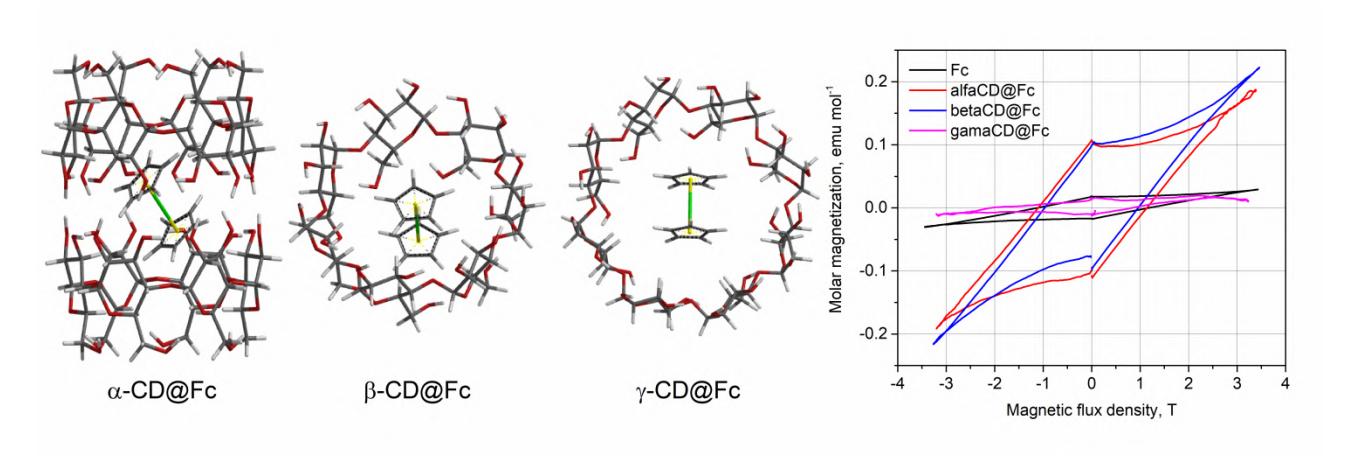
In this work, the supramolecular complexes based on ferrocene (Fc) as a guest and α-, β-, and γ-cyclodextrins (CD) as the hosts with chiral cavities were synthesized to achieve this goal. These inclusion complexes were characterized using nuclear magnetic resonance, vibration, and chiroptical spectroscopy methods to confirm their structures. Moreover, density functional theory was used to optimize and compare the possible structures of these inclusion complexes and analyse the Fc orientation in the cavities (Fig. 1). We found that the orientation of Fc in α- and β-CD is considered to be nearly parallel to the molecular axis of CDs while that of Fc appears to be close to normal to the molecular axis of the γ-CD. Based on molar magnetization of these supramolecular materials, ten times better molar magnetization for the α- and β-CD@Fc complexes than for starting Fc and γ-CD@Fc was observed (Fig. 1). This effect correlates with Fc orientation in the CD cavities and this makes it possible to stabilize the higher spin structures at applied magnetic field.