
Conventional material processing methods cannot meet the demands of high precision requirements for products with micro – scale dimensions [1]. For this reason, laser material processing has attracted more attention because of its accuracy and wide range of potential industrial application, such as micromachining [2]. Working with femtosecond pulses exhibits high microchannel micromachining accuracy and great quality in comparison to longer laser pulses, thus its' use is increasing in various industrial applications [3].
Although femtosecond lasers are great for micromachining applications, there are difficulties working on microchannel formation in glass. First of all, it is complicated to control the depth and shape of the channel a s it tends to taper [4]. Secondly, laser induced channel width and depth ratio control is not trivial as it depends on laser power, pulse frequency and number of passes [5], as well it depends on laser pulse wavelength, because for infrared pulses multi-phonon absorption dominates due to low photon energy, however, for ultraviolet (UV) pulses direct absorption dominates because of high photon energy. Since direct absorption leads of a smaller skin-depth, it is expected that UV wavelengths would yield better results in terms of microchannel form.
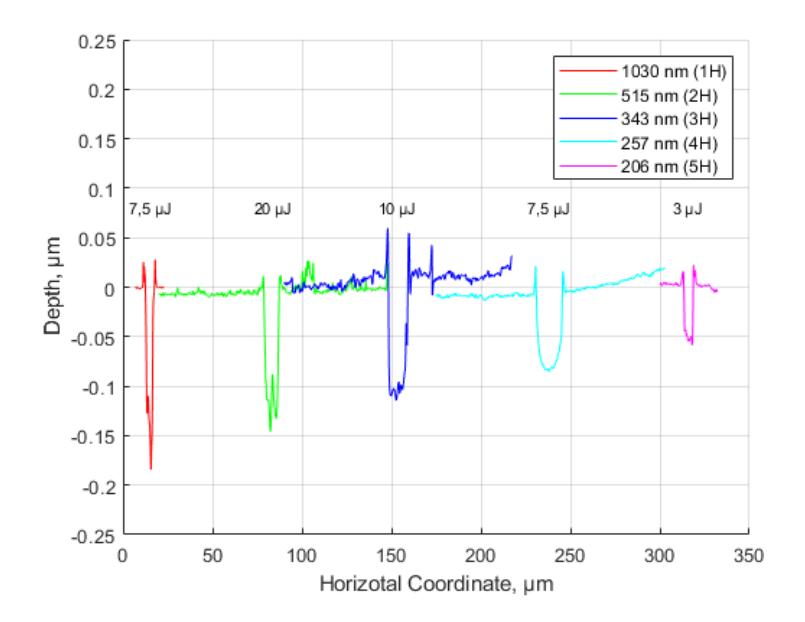
The aim of this study is to observe the properties of ablation of microchannels in glass using various wavelength femtosecond pulses (laser “Pharos"). During the experiment, microchannels were formed on the surface of soda – lime glass using different pulse energies, pulse count and wavelengths. The sample was moved using a positioning table "Aerotech ABL1500WB”. The shape of the microchannels, their depth dependence on fluence was examined using a laser scanning microscope “OLYMPUS OLS5000" and optical profilometer “SensoFar PLµ2300”. Fig. 1 shows the profiles of microchannels ablated with different wavelengths ranging from infrared to ultraviolet after one laser pulse. It was seen, that a higher depth of the microchannels was achieved using the 1st harmonic compared to the 4th and 5th ones because of different absorption mechanisms.