
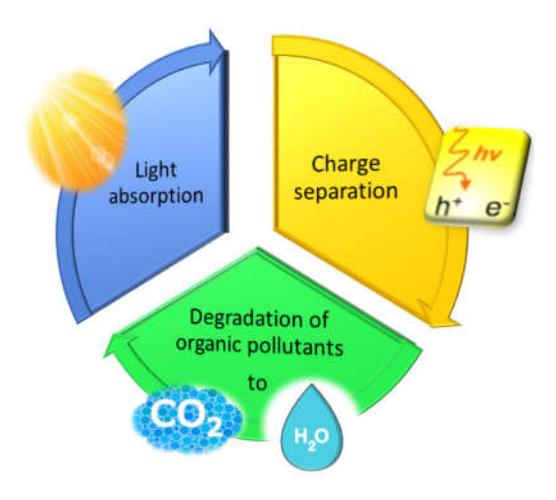
Water pollution seems to be a significant issue nowadays. Among many different approaches for water purification, photocatalysis (Fig. 1) starts representing a promising chemical waste-water treatment [1]. In this study, Sr0.9La0.1TiO3 and Sr0.25Ca0.25Na0.25Pr0.25TiO3 nano-sized powders were tested as photocatalysts for removing organic pollutants from water. Metoprolol (MET) is a widely used β-blocker that was detected in a surface water of rivers, in a concentration varying from 3 ng/cm3 to 4.9 μg/cm3 [2].
Performances of these two photocatalysts were examined for removing MET from the water under simulated Solar irradiation (SSI), UV, and LED irradiation. The concentration of MET was determined by HPLC-DAD analysis [3]. Results show a decrease of MET concentration from water up to 17% and 20% for 240 min under SSI by Sr0.25Ca0.25Na0.25Pr0.25TiO3 and Sr0.9La0.1TiO3, respectively. Improved efficiency of 30% MET removal was achieved by UV irradiation for both photocatalysts.
Chemical Oxygen Demand (COD) test was used to determine the amount of oxygen necessary to oxidize organic matter in samples in which photocatalysis have taken place for 240 min. Comparing the results of HPLC and COD, it was found that the studied materials are highly efficient in removing MET and intermediates formed during the degradation. The high mineralization degree, 27% with Sr0.9La0.1TiO3 and 19% with Sr0.25Ca0.25Na0.25Pr0.25TiO3 under UV light, indicates non-selective efficiency in removing organic pollutants.
All of the obtained results indicate a significant potential for future practical applications.