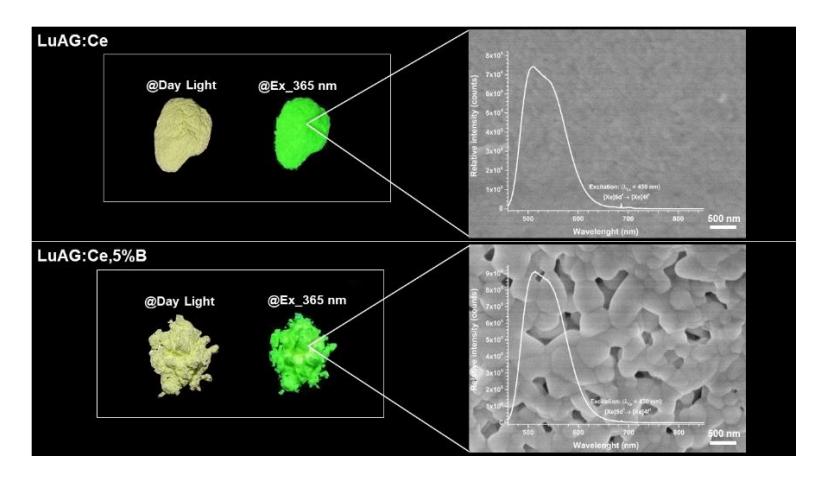
To convert high-energy radiation, such as gamma or X-rays, into visible light, a certain type of material is needed. Such compounds are usually referred to as scintillators. Over the years many different candidates to fit the required criteria were examined. Compounds with garnet structure have attracted a particularly large amount of attention as potential scintillators [1]. Cerium doped yttrium and lutetium aluminum garnets (YAG:Ce, LuAG:Ce), have high density, high thermal stability, a rather intensive emission/excitation and high quantum efficiency which are needed for a good scintillator. However, further optimization and improvement are still required, especially towards obtaining high luminescence intensity and even more so on the shortening of the decay time. One way to approach this problem is to alloy the aforementioned compounds with different elements, such as boron and magnesium [2,3]. By replacing one element with another in the crystal lattice it is possible to influence the properties of the materials. As such, by doping we could potentially be able to improve key aforementioned parameters: emission intensity (Fig. 1), quantum efficiency and decay times [2]. The form of the samples is also known to be and important factor for scintillators. Although the most common and easiest to work with form of the samples is powder, however coatings and ceramics are more applicable in practice. Therefore, when it comes to scintillators, it is important to consider this as well [4].
In the present work it is investigated the effect of boron doping on the various characteristic of the aforementioned garnets in a different form. This is especially important for ceramics and thin films as most of the scientific data is present only for compounds in powder form. In this research this doping was described as YAG and LuAG garnets in all three forms: powder, thin films and ceramics were synthesized and investigated. Garnets doped with different amounts of boron and/or magnesium were synthesized by the sol-gel method. The coatings were synthesized using the sol-gel spin and dip-coatings methods on different quartz and sapphire substrates and ceramics were obtained using hydrostatic pressure. Crystal structure of the samples was analyzed by means of X-ray diffraction (XRD). Morphology of the compounds was evaluated using scanning electron microscopy (SEM) and atomic force microscopy (AFM). Luminescence properties such as emission, excitation, decay time, quantum efficiency and temperature dependency of emission intensity have been investigated. Radioluminescence was also measured in order to determine the scintillation properties of the samples. The positive impact of boron addition into the garnet structure on the luminescence properties will be discussed in detail.