
Polyurethanes (PUR) are among the most widely used polymers due to the versatility of their properties. In order to perform pouring, filling, curing and other manufacturing operations properly, viscosity of the polymer blend has to be carefully controlled, especially when the polymer mixture is being exposed to the new surfaces. It might be expected for the viscosity to increase during polyaddition reaction, but previously, when an ether-ester macrodiol had been mixed with polyglycols and reacted with an isocyanate, a highly unusual drop in viscosity had been observed during early stages of polymerization [1]. In this study, instead of complex mixtures, two simple polyalkylene glycols were investigated for their viscosity variation during the addition reaction with a trifunctional isocyanate. Polyethylene glycol (PEG) of 400 g/mol and polypropylene glycol (PPG) of 2000 g/mol were reacted with a trifunctional adduct of hexamethylene -1,6-diisocyanate (HDI3, CAS 3779-63-3). The isocyanate was used at 1.4 mol excess, therefore HDI3 contents were higher than those of PEG. Before blending, the components were preheated to 50°C and their viscosities measured under different shear rates using Anton Paar MCR 302 rheometer with a concentric cylinder system [1]. Individually, PPG and HDI3 did not show much dependence on shear, recording 102.9, 102.2 and 102.1 mPa·s at 50°C under 1 s-1, 10 s-1 and 100 s-1 for PPG and 481.9, 481.7 and 481.4 for HDI3 respectively. PEG was thinning much faster with higher shear, resulting in 34.7, 30.2 and 29.5 mPa·s respectively. With both polyglycol and isocyanate preheated separately, they were blended together and the viscosity measurements were started within 1 min. Two mixtures were tested:
• "PPG+HDI3" (containing 78.7% wt. PPG plus 21.3% wt. HD13), and
• "PEG+HDI3" (containing 42% wt. PEG plus 58% wt. HDI3).
Theoretically, the initial values of the blend viscosity should have been quite similar for both PUR mixtures, assuming semilog dependence between the components and no polymerization, Fig. 1.
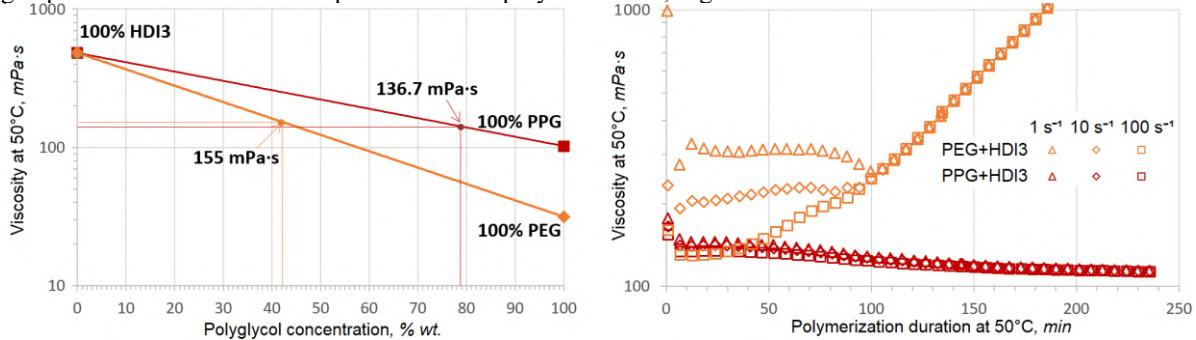
Measured initial viscosities under 100 s-1 shear rate nearly matched the predicted values. This suggests that semilog relationships might still be valid when predicting viscosities of non-reactive blends. However, viscosities of the PEG mixture appeared highly dependent on shear rate, showing many times higher magnitude than in case of individual components. When comparing the measurements of the same PEG mixture under 1 s-1 and 10 s-1, the values barely fit within the same order. In contrast, the PPG mixture did not show much shear thinning. Nevertheless, both mixtures thinned down during early stages of polymerization. PEG mixture eventually rebounded and its viscosity started increasing, while that of PPG mixture did not increase within 4 hrs. This might imply that the PPG polymerization is much slower compared to PEG, in agreement with previous studies [2], but the absence of the viscosity increase alone cannot implicate that PPG doesn't react. With progressing polyaddition viscometric trends eventually become Newtonian-like. However, the initial stages, which often are extremely important during manufacturing, could be very perplexing.
Conclusion. Viscosity variation of polyglycol and isocyanate blends might be highly complex and demonstrate a reduction in viscosity despite ongoing polymerization. The drop in viscosity might be related to a gradual depletion of hydroxyl groups, but more testing is needed to assess this effect.