The wavelength of laser radiation is usually constant and changing it is extremely hard, which is why, in practice, parametric light generators are used, which allow to continuously change radiation wavelength in a wide spectral range. Currently, the parametric generators are created with ultrashort (less than 100 ps) and long (more than 1 ns) pulse durations, however subnanosecond pulse (less than 1 ns and more than 100 ps) generators have not yet been invented, this is due to certain physical limitations [1-3].
The goal of this research was to construct and investigate an optical parametric amplifier (OPA), which uses 15 mm beta barium borate (BBO) crystal as a nonlinear medium and Nd:YAG MOPA laser as a pump source. Here, fundamental harmonic (1064 nm) was used as pump source for seed radiation, and 3rd harmonic of laser (355 nm) – as pump radiation for the OPA. The seed was supercontinuum generated in a 1 m long solid-core highly nonlinear photonic crystal fiber (PCF).
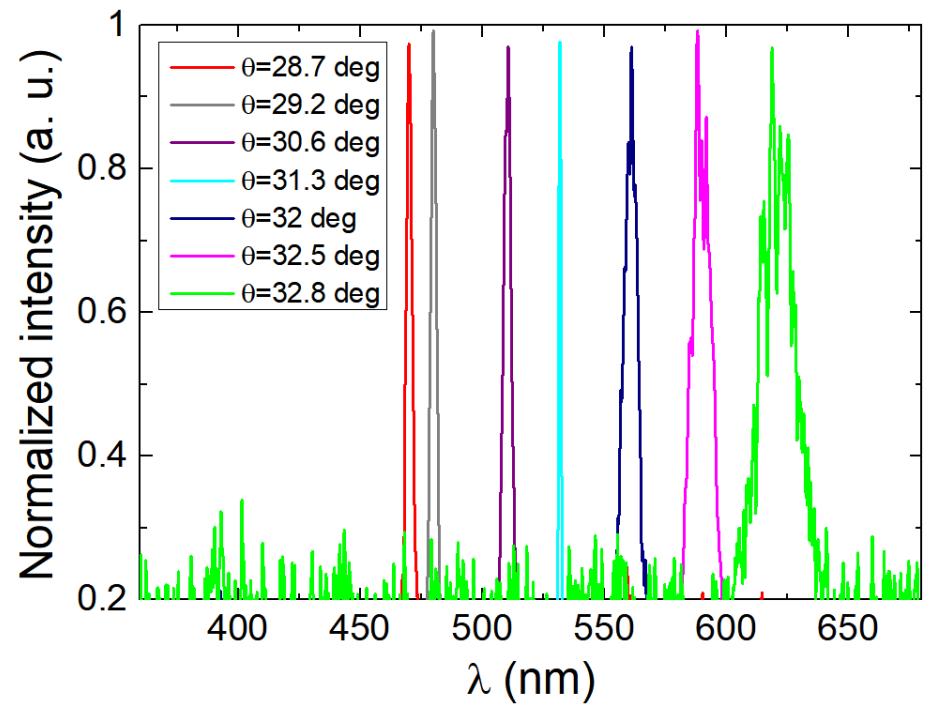
The supercontinuum radiation extended from 720 nm to 1600 nm at maximum pump pulse energy. The maximum seed energy was measured to be 5.7 mW over the entire spectrum. We achieved signal wave generation via optical parametric amplification of idler wave. Further on, we measured spectral and energy characteristics of OPA. Signal wave tuning range was from 470 nm to 660 nm and was limited by idler wave tuning range which depends on seed radiation spectrum extension (idler wavelength tuning range was from 768 nm to 1450 nm). Generated signal wave power was low (of the order of microwatts) over the whole wavelength tuning range due to the fact that seed radiation spectral power density was low, pump intensity was also relatively low and limited by the laser induced damage threshold (LIDT) in the BBO crystal. Moreover, strong spatial walk-off effect between pump and signal/idler waves in the BBO crystal also limited parametric amplification efficiency. The experiment data was consistent with numerical simulation of the BBO OPA.
The results of this work will be used for further development of more effective subnanosecond OPA systems.