Dimethylammonium metal-formate frameworks [(CH3)2NH2][M(HCOO)3] (DMAM, where M = Mn, Fe, Co, Ni, Zn, or Mg) are currently some of the most studied hybrid perovskite materials due to their magnetic, ferroelectric and multiferroic properties[1, 2]. Such materials have a typical perovskite structure (ABX3), where the metal and formate ions form a framework with cavities that are filled with (CH3)2NH2+ (DMA+) cations. The mechanical, magnetic and electric properties of such materials are determined by the hydrogen bonds that are formed by DMA+ cations with the rest of the framework. Most DMAM materials exhibit phase transitions, in which the DMA+ cations cooperatively form highly ordered structures and thus deform the metal-formate framework, leading to changes in magnetic and dieelectric properties[2, 3],
Many experimental methods have been used to study these frameworks and the cation dynamics within them [1, 2, 3]. However, none of these methods allow for elucidation of detailed, atom-level cation dynamics and their relation to the magnetic properties of the materials. Molecular dynamics simulations allow for detailed analysis of particle motion, calculated via Newton's equations using empirical sets of effective interatomic potentials.
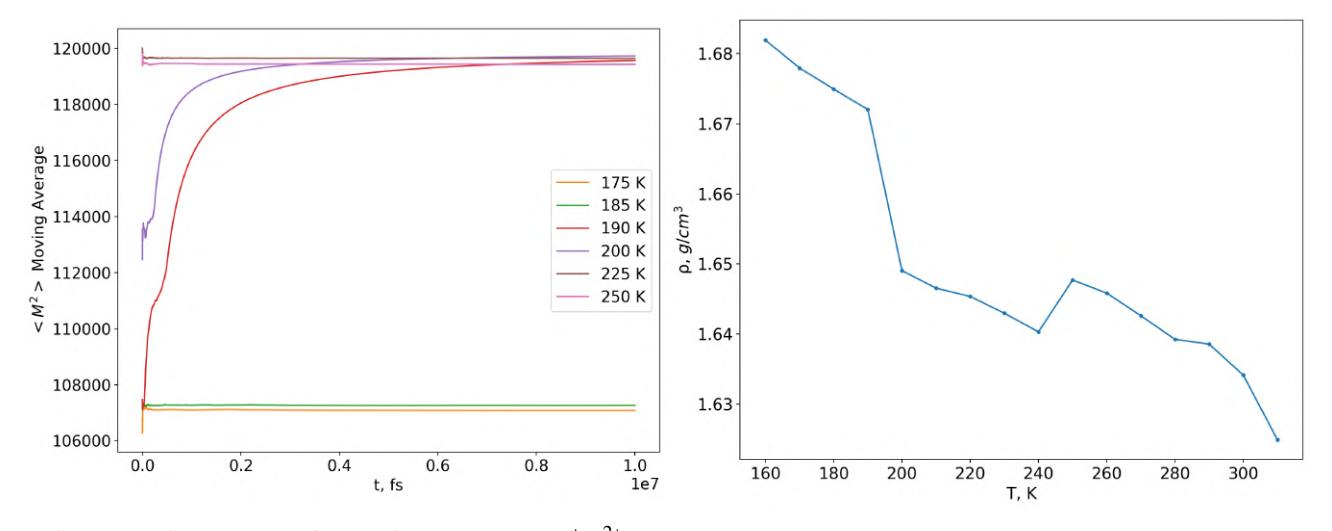
In this study, the calculations of DMA+ cation dynamics in DMAZn were performed using the General AMBER Force Field (GAFF) [4] and the Universal Force Field for Metal–Organic Frameworks (UFF4MOF) [5]. Cation dynamics and magnetic properties were analyzed at different phases and temperatures by calculating autocorrelation function of cation vector orientation and the moving average of total dipole moment of the system (Fig. 1). Physical properties, such as density and its dependence on temperature (Fig. 2) were compared with experimental data. The results show poor agreement between experimental results and GAFF simulations, but much better agreement in the case of UFF4MOF simulations, suggesting that more specialized force fields are needed for accurate results from molecular dynamics simulations.