
Superhydrophobic coatings are not widely used due to high cost, difficulties in scaling and low mechanical resistance. The way to solve these problems is to use the conventional application methods that are used for organic paints (brush, roller or airspray coating) to facilitate scalability and the use of components that can reduce the cost [1]. This approach involves the use of fillers - materials in the form of particles with the desired particle shape, or it can be materials treated to obtain water-repellent properties. Nanoparticles are good candidates, but they have low mechanical resistance, so they can be combined with microtextured particles [2]. Lamellar particles can minimize the contact area of a water droplet with a substrate. Such particles can be mica, talc, or ground expanded perlite [3].
Expanded Aragats perlite was used in the work. For surface treatment of crushed perlite was found that the most effective agent is polymethylhydrogensiloxane. Styrene-acrylate copolymer was used as a polymeric binder. For the water contact angle is the ratio of polymer and filler: when the polymer content is more than 50 wt. % and more than 40 wt. % for untreated and treated perlite, respectively, the Cassie steady state is achieved. More than 140 degrees water contact angle has been achieved. When crushed, expanded perlite has a large internal volume that acts as an air gap to maintain Cassie's condition. The mechanical wear resistance of the coatings was determined by sand test (average particle size 350 μm) and results shown on Fig.1. The value of the contact angle with water does not depend on the thickness and does not drop significantly during the test due to the high wear resistance of the siloxane layer on the surface of the particles.
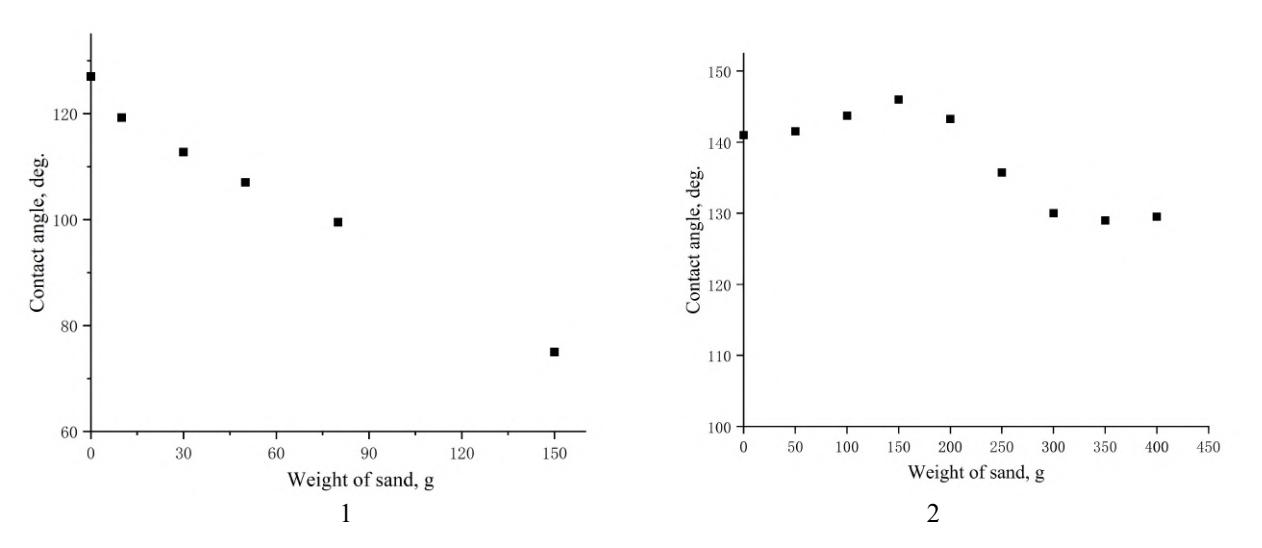
After grinding and treatment with polymethylhydrogensiloxane, expanded perlite can be used as a filler for superhydrophobic coatings due to various particle shapes from flat to irregular. As a result, the coatings have porosity, which as a result provides high values of water contact angle after mechanical wearing. These coatings can be considered as a base layer for creating hierarchical superhydrophobic coatings.