
Nowadays, the most common ways of administering drugs are orally, e.g. in the form of tablets or directly into the blood through injections or drips. Despite the many advantages of the oral administration, one of the problems is the first pass effect also known as first-pass metabolism, that causes a reduction of the drug concentration before it reaches the systemic circulation. First-pass metabolism may occur in the liver or in the gut. [1] Another problem is poor solubility of some active compounds in water.
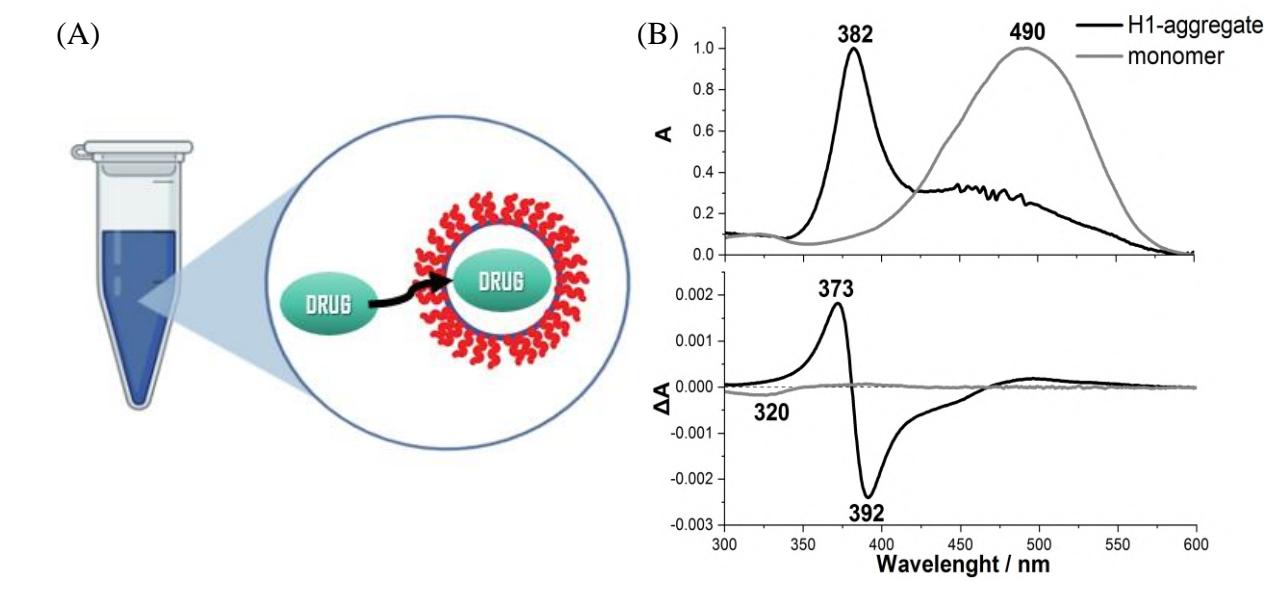
Solutions to these problems, may be, firstly, the administration of the drug directly to the target site, and second, encapsulation. This method is based on the confinement of an active compound inside the cavity of a larger structure. In our research, we use polymer micelles to encapsulate active compounds (Fig. 1A), for example astaxanthin, for their successful administration to adipocytes. We used poloxamers, a triblock copolymer consisting of hydrophilic poly(ethylene oxide) (PEO) blocks and hydrophobic poly(propylene oxide) (PPO) blocks [2], that forms micelles quickly, simply and effectively in the aqueous solution. Due to its amphiphilic structure, it has surfactant properties, thanks to which it is widely used in industry, pharmacy and cosmetics.
Chiroptical spectroscopies, in particular Electronic Circular Dichroism (ECD), supported by Vibrational Circular Dichroism (VCD) and Raman Optical Activity (ROA) were used to study the encapsulation process. Transmission electron microscope (TEM) was used to check the shape and size of formed micelles. Raman microscopy was applied technique to visualize the delivery of the active compounds from the micelles to adipocytes and the active compound distribution in the cells.
Among studied compounds, we investigated encapsulation of carotenoids that are practically insoluble in water. Carotenoids in mixed solvents and in the protein environment can form aggregates. [3-5] Our results demonstrate that astaxanthin forms stable H-aggregates in micelles (Fig. 1B) and in the encapsulated form can be successfully delivered to primary adipocytes isolated from mice.