DELAYED MORTALITY AND SUBLETHAL EFFECTS OF COLD STRESS IN DROSOPHILA MELANOGASTER
Vladimír Koštál1, Robert Grgac2, Jaroslava Korbelová1
1 Biology Centre CAS, Institute of Entomology, Czech Republic
2 Faculty of Science, University of South Bohemia, Czech Republic
Analysis of sublethal responses in cold-stressed insects can provide important information about fitness costs and a better understanding of the physiological mechanisms used to prevent and/or to cope with cold injury. Yet, such responses are understudied and often neglected in the literature. Here, we analyzed the effects of cold stress applied to larvae on the mortality/survival and fitness parameters of survivor adults of the vinegar fly, Drosophila melanogaster.
Third instar larvae (either cold-sensitive or cold-acclimated) were exposed to either supercooling or freezing stress, both at -5 °C. A whole array of sublethal effects were observed, from mortality that occurs with some delay after cold stress, through delayed development to the pupal stage, to shortened life-span of the adult, and decreased female fecundity.
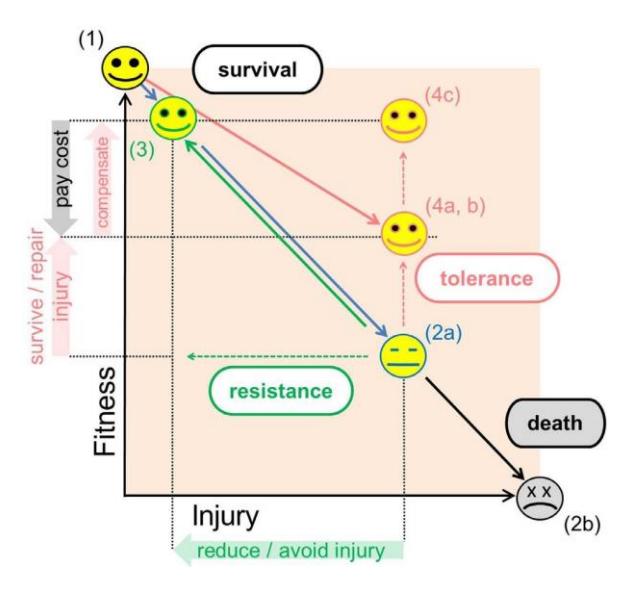
Taking the sublethal effects into account improves the ecological meaningfulness of cold hardiness assay outcomes. For instance, we observed that although more than 80% of cold-acclimated larvae survive freezing to -5 °C, less than 10% survive until adulthood, and survivor females exhibit more than 50% reduction in their fecundity relative to controls. Female fecundity was positively correlated with dry mass and negatively correlated with total protein and glycogen stores. Hence, these parameters may serve as good predictors of survivor adult female fecundity. Further, we provide the concept of a two-component defense system, which (based on analysis of sublethal effects on fitness parameters) distinguishes between physiological mechanisms that help insects to resist (reduce or avoid) or tolerate (survive or repair) injuries linked to cold stress.
Fig. 1. Concept of a two-component defense system to cope with cold stress injuries. (1) control animal (not exposed to cold stress) shows maximum survival and maximum fitness (upper left corner of diagram); (2) having no mechanisms of cold hardiness available/activated, the animal exposed to cold stress would suffer from cold injury, which would severely decrease its fitness (2a, blue arrow) or, ultimately, would result in lethality (2b, black arrow); (3) the resistance mechanisms (green arrows) help to reduce (or avoid) injury at a given dose of cold stress (combination of temperature, time, supercooling/freezing), which means that the animal survives and maintains high (3) (or even max) fitness without any need to pay costs after the cold stress (of course, recruitment of resistance mechanisms prior to cold stress – during acclimation, may need allocation of energy resources); (4) the tolerance mechanisms (pink arrows) help to cope with the injury that incurred during a given dose of cold stress, which means that the animal survives, but its fitness may be significantly impaired due to: (4a) deleterious consequences of un-repaired injury; (4b) cost of energy expenditure at the expense of larval resources required to repair the injury. Alternatively, (4c) fitness is not reduced because the cost of repair is either small or compensated from external energy resources. This concept has been adapted from Råberg et al., 2007 [1] and Schneider and Ayres, 2008 [2].
[1] L. Råberg, D. Sim, A.F. Read, Disentangling genetic variation for resistance and tolerance to infectious diseases in animals, Science318, 812-814 (2007).
[2] D.S. Schneider, J.S. Ayres, Two ways to survive infection: what resistance and tolerance can teach us about treating infectious diseases, Nature Reviews Immunology8, 889-895 (2008).