
Galactic activity undoubtedly plays a major role in the evolution of galaxies. Energy released during activity episodes initiates galaxy-wide material transport - an outflow forms. Outflows are multiphase systems with a wide range of physical properties. Cooler, slower outflows are found within a few kpc of the galactic nucleus, have wide opening angles and affect the whole galactic disc. The galactic disc is rich with molecular clouds - dense, cool star forming regions. These cradles for stars are responsible for chemical evolution of the galaxy. Molecular clouds have been measured extensively and their properties obey Larson laws [1]. These laws describe size, mass and turbulent energy of clouds in quiescent galaxies.
Turbulence is undoubtedly one of the main factors that determine the distribution of matter in evolved molecular clouds. The turbulent velocity field results in formation of eddies and star formation occurs in the densest knots of these filaments. Turbulent flows are probably the last unsolved problem in classical mechanics. One of the major advances was statistical description of turbulence, where kinetic turbulent energy distribution in eddies obeys a power law. In Fourier domain it takes the form $E \sim k^{-n}$, where n describes the steepness of energy distribution in inverse wave number space. Turbulent vortexes can be split by types. These types are closely connected to basic fact of vector analysis: any continuous vector field (e.g. turbulent velocity) can be decomposed into orthogonal components
$$\mathbf{v} = -\nabla \Phi + \nabla \times \mathbf{A}.\tag{1}$$These components are described as compressive and solenoidal, respectively. Compressive field works in the direction of the gravity well surrounding a dense clump. The solenoidal field, on the other hand, can be visualised as a vortex. In computer simulations turbulence is often initialised as a purely solenoidal field. However, this involves making several implicit assumptions - the gas is incompressible and the velocity field is homogeneous. But it is naive to expect for gas to be incompressible in molecular clouds. For realistic molecular clouds a compressive turbulent field component must be present. Therefore it is of particular interest to explore the effect of different types of turbulence, where the ratio of solenoidal to total turbulence $\tau$ is between 0-1.
We use the SPH code Gadget 4 [2] to model hydrodynamics and gravity; we include relevant cooling and heating processes via a cooling function. The model used in this work can be described as a virtual wind tunnel where a stationary molecular cloud with mass of 105 M☉ is ablated by outflows with velocities of 10 - 200 km/s and temperatures of 104, 105 K. For each system we measure the fragmentation time, defined as the time when the mass of cool dense clumps reaches 2% of initial cloud mass.
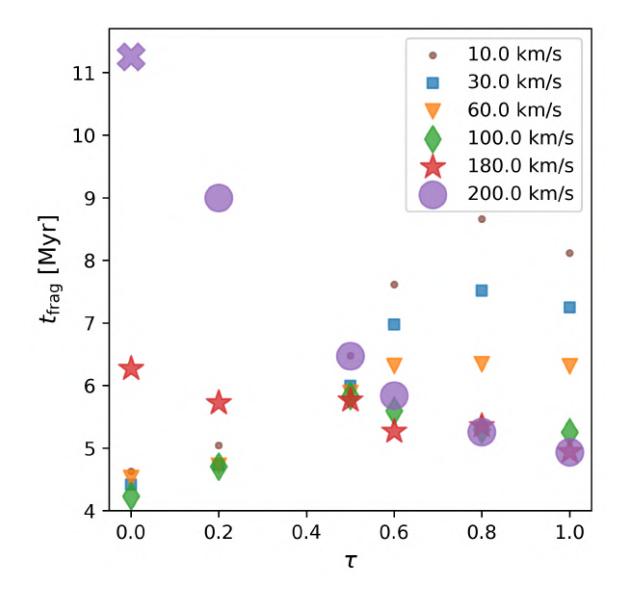
As expected, at speeds $\leq 100$ km/s, compressive turbulence $\tau < 0.5$ works in hand with gravity and gas collapses much faster. For higher $\tau$ solenoidal velocity field produces less dense regions and they evolve slower. Kinematic outflow pressure has almost no effect for $\tau < 0.5$. Above this value anti-correlation in outflow velocities and fragmentation time is observed. However outflows with velocity $\geq 180$ km/s no longer induce gas collapse for $\tau < 0.5$, but lead to delayed fragmentation or even destruction of the cloud. Kinetic and thermal pressure of the outflow combined with compressional turbulent field accelerate cloud material, which overshoots local potential well and cloud disperses.