
To counter the rising energy demand of humanity a new energy source – fusion – is being researched. A new fusion reactor ITER is being built in France with first plasma scheduled in 2025. ITER tokamak is unique because it will have tenfold return of energy thus being the first fusion reactor to have positive net power. [1]
The fuel to be used in ITER will be deuterium (D) and tritium (T) mixture. Safety regulations require observations of T retention in plasma facing components since T is radioactive [2]. Therefore, it is necessary to develop diagnostical methods to measure fuel retention in walls of ITER. One such method suitable for use in ITER is laser-induced breakdown spectroscopy (LIBS).
LIBS apparatus uses a powerful laser pulse which is focused on a small spot on the investigated material. A small amount of the material is ablated and heated into plasma plume. The plume emits light characteristic to the investigated material and the emission spectrum of the plume is then used to determine the elemental composition of the material.
Calibration-free LIBS (CF-LIBS) is considered because exact calibration of LIBS for ITER conditions is very difficult. However, application of CF-LIBS requires the fulfilment of certain conditions in the laser-induced plasma and deviation from these conditions might lead to erroneous results. The aim of this work is to estimate the fulfilment of one such necessary condition for CF-LIBS: local thermodynamic equilibrium (LTE).
Experiments were carried out in argon environment at different pressures. The investigated material was molybdenum with hydrogen impurities to simulate ITER-relevant materials. Spectra were recorded at delay times from 200 ns to 6 μs after the laser pulse and at different distances from the target depending on the plume expansion.
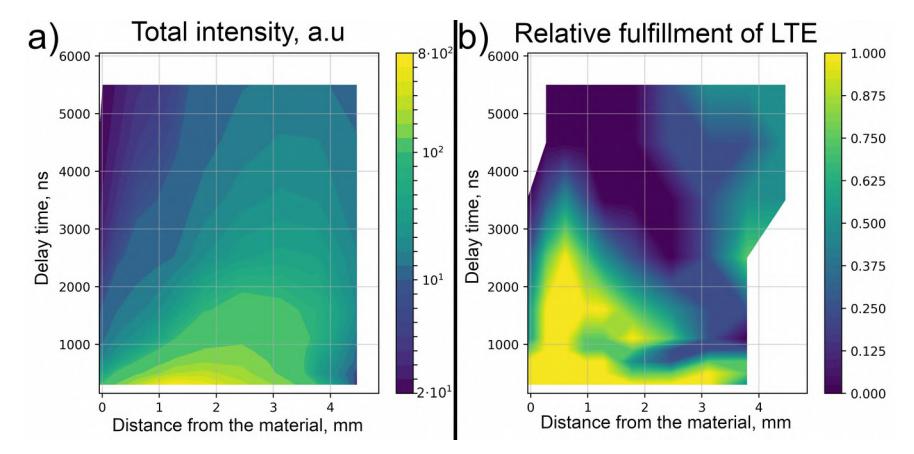
Occasionally CF-LIBS might determine erroneous hydrogen isotope concentrations. The experiments show that one source of errors is the deviation from LTE. Three criteria for the existence of LTE were considered (Fig. 1). Under no conditions were all criteria completely fulfilled. Further research is needed to characterize the relation between CF-LIBS accuracy and the relative fulfilment of LTE.
This work has been carried out within the framework of the EUROfusion Consortium, funded by the European Union via the Euratom Research and Training Programme (Grant Agreement No 101052200 – EUROfusion). Views and opinions expressed are however those of the author(s) only and do not necessarily reflect those of the European Union or the European Commission. Neither the European Union nor the European Commission can be held responsible for them.