Amphotericin B (AmB) is an antibiotic that is a golden standard in the treatment of fungal infections [1]. It's exceptional effectiveness in therapeutic action is accompanied by significant side effects. Despite many years of using this drug the mechanism of the therapeutic and toxic effect has not been thoroughly understood, which makes AmB subject of numerous scientific studies [2]. The antibiotic's amphiphilic properties results in the ability of AmB to self-association and self-aggregation into numerous molecular structures which affects the way the antibiotic works and the dependence of these processes on many environmental factors makes the topic more complex [3].
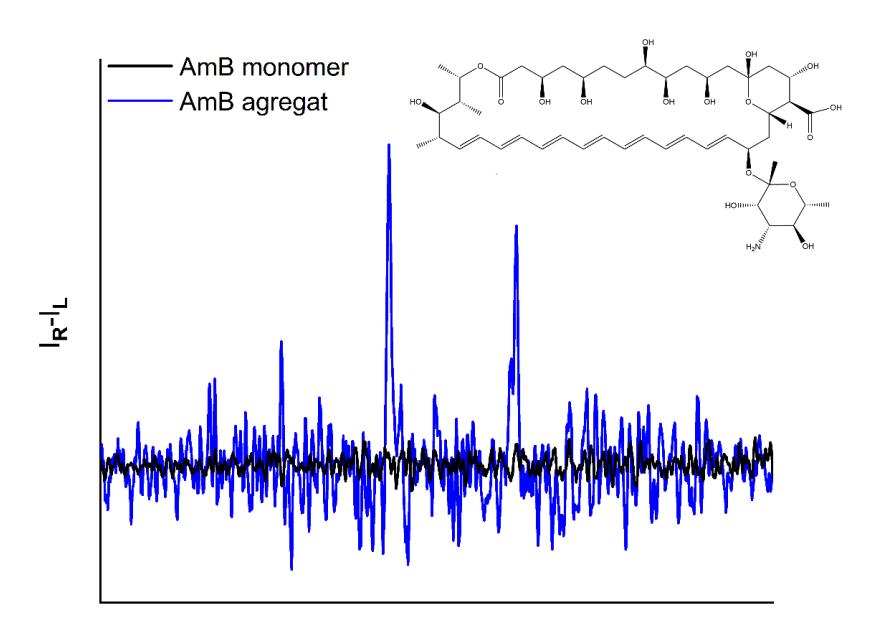
In the present study, we analyzed various molecular forms of AmB by means of spectroscopic methods like UV-Vis absorption spectroscopy, Raman spectroscopy and chiroptical methods, such as Electronic Circular Dichroism (ECD) and Raman Optical Activity (ROA). It was confirmed that the aggregation process of the antibiotic is highly sensitive to environmental conditions but also to the method of sample preparation. The research has shown that AmB can occur in the form of J and H aggregates, showing characteristic bato- and hypsochromic band shifts on the UV-Vis and ECD spectra. Additionally, spectroscopic changes in the Raman spectra were analyzed and marker bands of aggregation process were identified. An extremely important research aspect was the statement that supramolecular aggregates of AmB generate a pre-resonance ROA signal unlike the monomer form. It is caused by the process of self-assembly of molecules into larger systems. Because of that, Aggregation-Induced Resonance ROA (AIRROA) may be a very useful method to obtain the ROA signal. Pre-resonance ROA spectra of AmB monomer and super-aggregate confirming that statement were shown in Fig. 1.