
The sarpagine family is a major class of structurally related monoterpenoid indole alkaloids (Fig. 1), naturally occuring in the dogbane (Apocynaceae) family of plants. Historically, the extracts of these plants have been used in traditional medicine to treat a variety of illnesses – for example, the Indian snakeroot (Rauvolfia serpentina) contains a wide variety of sarpagine, macroline and ajmaline alkaloids and has been used as a source of the phytochemical reserpine. Curiously, the extracts from this plant are used up until modern day in the treatment of systolic hypertension [1]. Unfortunately, natural occurrence of these compounds is scarce, therefore making sarpagine alkaloids an interesting and challenging synthetic target. To date, Cook et al. have synthesised a variety of these compounds elegantly employing Pictet-Spengler type chemistry [2], laying down the foundation to synthetic sarpagine research. Unfortunately, this pathway is almost impossible to scale due to the length of the total syntheses (up to 15 steps), making it extremely challenging to furthermore clinically analyze these compounds and find potential pharmaceutical applications.
We suggest a conceptually novel approach towards the total synthesis of these complex molecules employing azabicyclo[3.3.1]nonanes. Using these compounds would enable easily applicable large scale synthesis; furthermore, the length of the synthesis would drastically decrease (Fig. 2). Past efforts have shown an easy way to obtain enantiomerically pure bicyclic diol 1 using lipase from Candida rugosa [3].
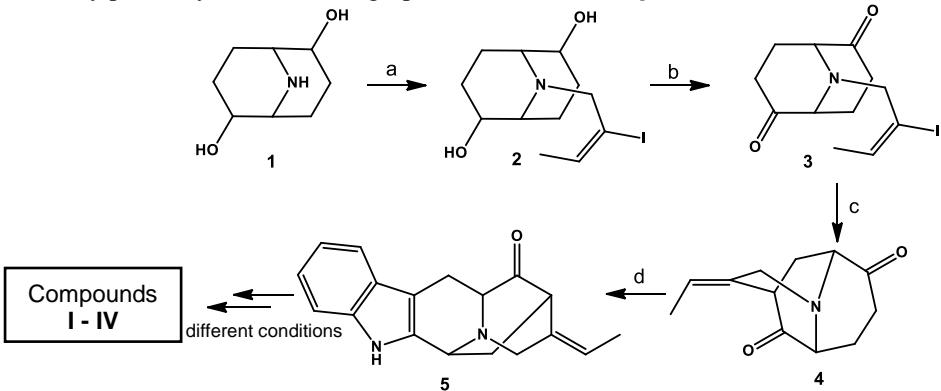
To date, we have successfully synthesised and identified compounds 1-5, establishing a promising pathway towards the final products, such as vellosimine, normacusine B, pericyclivine and other congenerates.