
Nonwoven materials based on ultra-thin fibers are used to make bandages for burns, wounds of various origins and trophic ulcers from biocompatible and biodegradable polymers. The use of such materials demonstrates high air and vapor permeability and accelerates skin regeneration. The use of chitosan as a polymer carrier is due to the presence of reactive amino groups in protonated form [1, 2]. The introduction of chitosan into the composition of ultra-thin fibers of the obtained nonwoven materials makes it possible to expand their scope due to the possibility of interaction with other modifiers [3].
Experimental ratios of the composition of PVAc and PVA to chitosan dissolved in lactic acid are 1:1, 3:1 and 4:1. When the content of chitosan (1:1), (3:1) content takes place drop formation, which leads to impossible electrospinning.
The ratio of PVA with chitosan (3:2) led to insufficient electrospinning, the fibers were short, reducing the distance between the electrodes (ex. >7 cm). The solution in the ratio of PVAc and PVA with chitosan in the ratio (4:1) and the distance between the electrodes of 9 cm showed good results the electrospinning process. The nonwovens obtained from the PVAc / Chitosan and PVA / Chitosan compositions have fibers with a diameter in the range of 0.05-0.45 μm (Fig. 1). The use of a solution of chitosan in lactic acid improves the electrospinning.
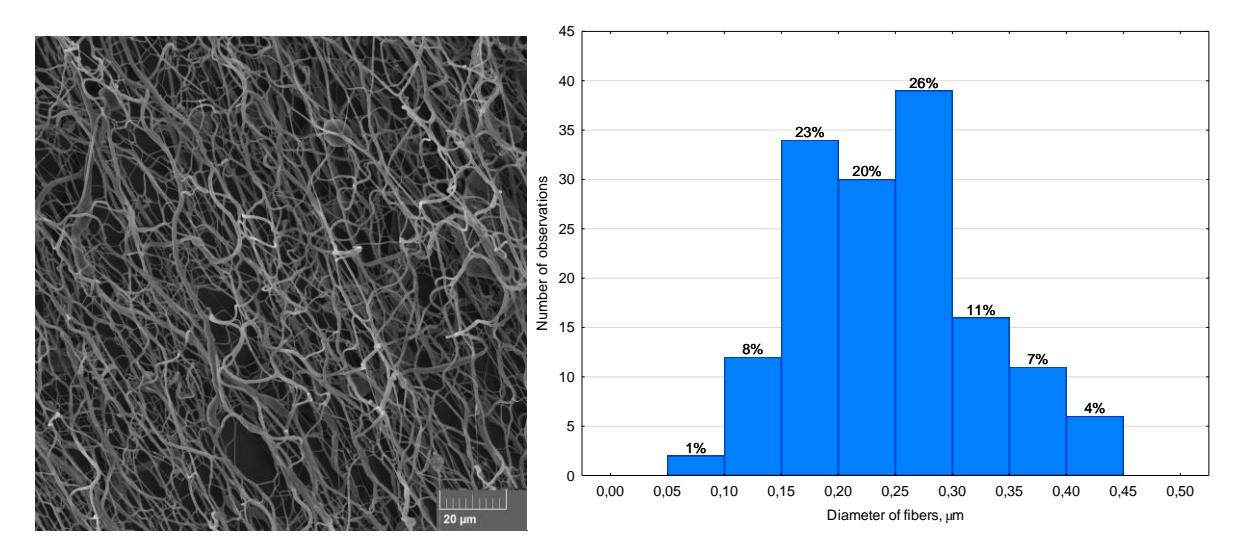
It is shown that the introduction of 2-ethoxy-6,9 diaminoacridinium-3-nitroanthranylate (antiseptic drug SG 112) to ultrathin fibers provides the formation of antiseptic properties for the obtained nonwovens. The use of SG 112 increases the fiber diameter to 0.4-0.75 μm, but reduces the width of the distribution of the formed fibers by diameter.
Studies of fungal resistance of nonwovens were performed in a nutrient medium Chapek-Dox. Nonwoven materials based on PVAc and PVA with the addition of solutions of chitosan in lactic acid and the antiseptic drug SG112 showed high air permeability (2.07-2.55 mg/cm2·h), controlled solubility in water, and good antiseptic properties. A positive result was considered to be the absence of fungal growth on the surface of nonwoven fabrics.
It has been shown that the process of thermal stabilization of nonwoven materials based on ultrathin fibers for 1-3 hours can regulate water absorption from 350 to 780%.