Graphene, 2D nanomaterial with hexagonally shaped carbon atoms is one of the most researched exotic materials due to its many peerless properties, which are believed to pave the way for future high-speed electronics, solar cell technologies and many more [1]. Even though graphene has a lot of potential, its applications in various technologies are rather limited by a very complex transfer process, which prevents graphene's large-scale synthesis. To overcome that, microwave plasma enhanced chemical vapor deposition (MW-PECVD) is used as a viable method for production of graphene on various dielectric and semiconductor substrates [2]. However, etching is one of the most prominent mechanisms that prevents graphene growth in PECVD related systems, thus protective enclosures are usually used to suppress it [3]. As monocrystalline Si(100) is still the most often used substrate for the fabrication of microelectronic devices, solar cells, and different photodiodes, catalyst-less and transfer-less graphene synthesis on Si(100) using a direct microwave plasma system was considered in the present study.
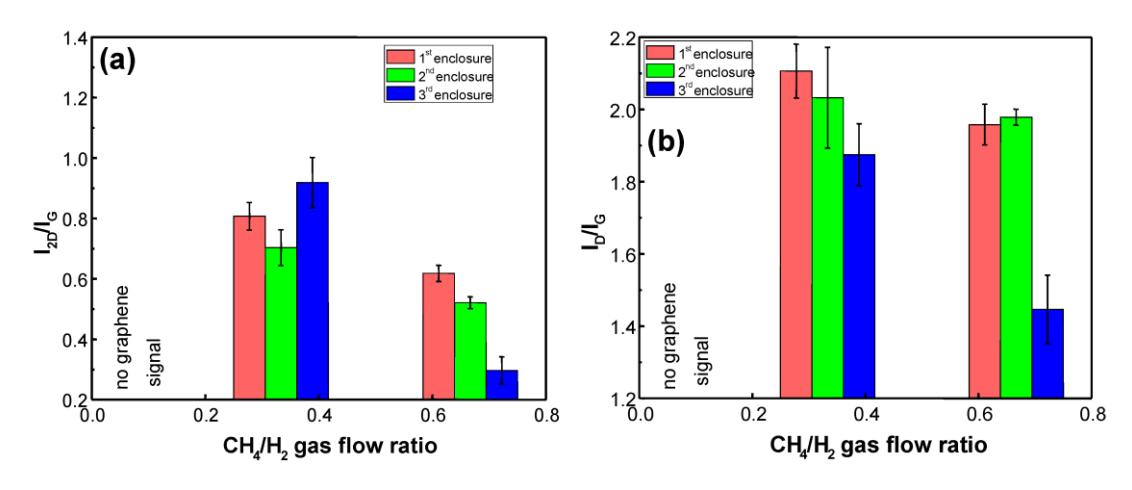
In this work, graphene was grown on the Si(100) substrates by using MW-PECVD system (IPLAS Innovative Plasma Systems GmbH) and four different protective steel enclosures. 1st - 3rd enclosures are circular with different hole diameters and arrangements on top (3.5 mm, 2 mm and 3.5 mm with no holes at the top respectively) with a 4th enclosure having a simple open ended rectangular configuration. The characterization of samples was carried out using Raman scattering spectroscopy (Renishaw inVia, 532 nm) by evaluating I2D/IG and ID/IG, peak intensity ratios.
Altogether, it is clear, that the most detrimental parameter in graphene synthesis, using our system, is the CH4/H2 flow ratio. Based on Raman spectra findings, CH4/H2 ratio as low as 0.11 produces no graphene, while increasing it to 0.33 gives a clear graphene fingerprint (I2D/IG for 1st, 2nd and 3rd enclosure is 0.81, 0.7 and 0.92 respectively). Further increase of methane flow compared to hydrogen flow increases the number of layers as evident from the decrease of I2D/IG (for 1st, 2nd and 3rd enclosure, I2D/IG ratio is 0.62, 0.52 and 0.3 respectively).
No top-hole size effects were found, when studying enclosure designs. The absence of top holes in the middle of the enclosure (3rd) reduced the plasma effect on the growing graphene and decreased defect density. The graphene was also successfully synthesized using just a rectangular steel sheet folded in two places as a simplified protective enclosure (4th).