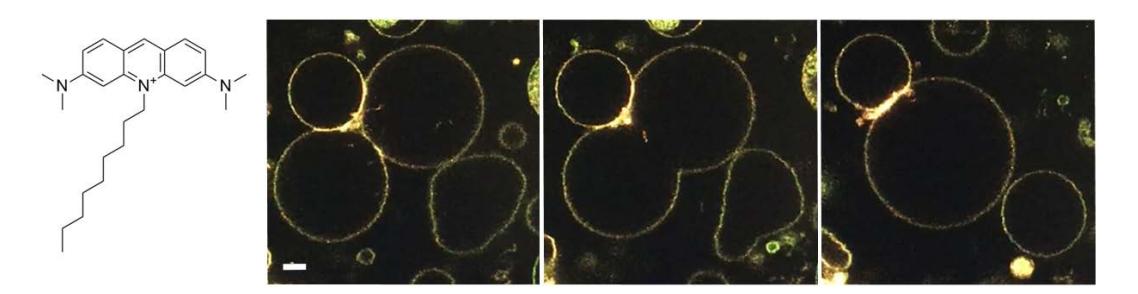
Nonyl acridine orange (NAO) is a fluorescent molecule that has traditionally been used for mitochondrial staining due to its affinity for cardiolipin lipid. Recent studies have shown that, at certain concentrations, it has the ability to stack forming H-aggregates in an antiparallel configuration, promoting events related to membrane remodelling [1]. In this work, we report fusion events on giant unilamellar vesicles (GUVs) containing DOPE lipid promoted by NAO. To enlight the underlying mechanism on these fusion events we have also synthesized derivatives of the molecule making modifications over its structure: removing its tertiary amine arms and decreasing its hydrocarbonated tail length or increasing it showing that the absence of sided amines and short tail chains avoid the process. To understand this relationship within the molecular structure, we approached the system by coarse-grained molecular simulations under Martini3 framework [2]. Results revealed a lipid-hook mechanism that triggers the process by displacing acridine derivatives molecules out of its equilibrium position. This remodelling enables the contact between lipids from different bilayers yielding to a hemifusion state of the system that would evolve into full fusion as seen on experiments.