High quality and precision micro fabrication of transparent materials has been quite a challenge in the past. Fortunately, recent advancements in industrial-grade laser systems, delivering ultrashort high-intensity femtosecond pulses has made it possible to process even high bandgap materials. However, typical photon energies from solid-state laser's first or second harmonic are not sufficient to induce linear absorption in almost all transparent materials and therefore only a nonlinear absorption mechanism can excite materials electrons to a conduction band and sustain the ablation process. Yet, the smoothest ablation results with low heat affected zones (HAZ) are expected in the linear absorption regime. That is why UV lasers where the energy of photons is large enough for a linear absorption can lead to better results than using IR or visible spectrum [1]. Currently, most of the research in ablation with UV light is conducted usually with excimer lasers delivering longer nanosecond pulses [2, 3]. It is well known that shorter pulses have characteristic timescales much smaller than the material's atomic vibrations timescale and produce reduced HAZ which causes better ablation precision and quality if compared to longer pulses. For this reason, higher harmonics of solid-state femtosecond lasers could be a better choice if compared to excimer nanosecond lasers.
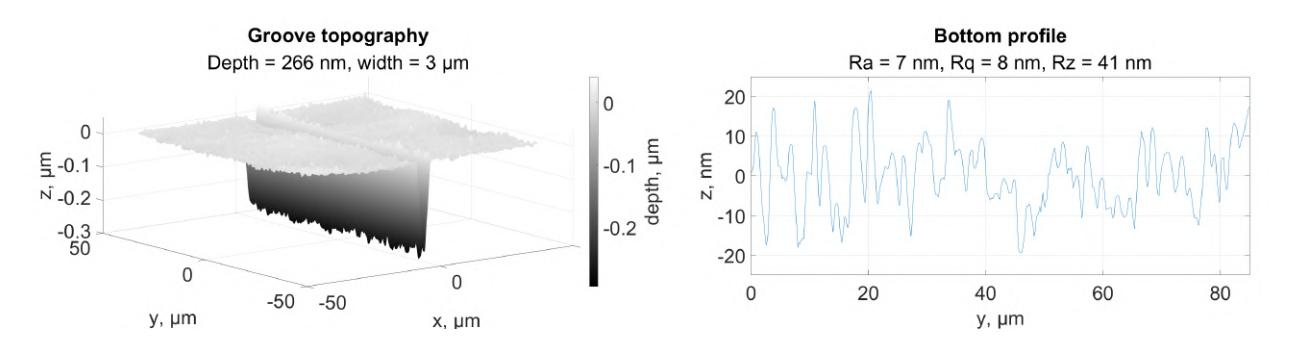
In this study, we present femtosecond laser (206 nm, 50 kHz, 210 fs) ablation results on Sapphire, BK7 and LiNbO3 crystal. Groove formation experiments were performed with Yb:KGW laser system (PHAROS, Light Conversion) with 5th harmonic generator, Aerotech ANT180 micro-positioning system, and calcium fluoride lenses for beam focusing. The parametrical analysis of ablation outcome versus processing parameters is presented which indicates that UV machining can produce high-quality grooves absent from HAZ without any additional post-processing. We demonstrate, that roughness values in the order of tens of nanometers and sometimes even less than 10 nanometers can be achieved and that is sufficient for fabrication of micro optical components.