
Conventional material processing methods are being replaced by modern laser micromachining, as lasers are great tools when working with micro/nano scale objects, exhibits excellent machining and edge quality applicable in industry such as making miniature watch internal parts or nozzles in ink jets [1]. Most lasers emit beams having a Gaussian intensity distribution [2], though the peak of the distribution may initiate strong ablation of the material, the periphery of the beam may not be sufficient for material ablation, and the material may undergo heating and the micromachining quality decreases [3]. In addition, due to a non-zero gradient of the Gaussian beam the depth of the ablated channels tends to saturate and the profiles are not cylindrical and resemble a a V-shape. The peripheral damage may be reduced if a non-Gaussian intensity distribution is used [5]. Using a different beam intensity distribution such as a top-hat beam may be beneficial as it is reported that it reduces the heat affected zone and improves micromachining quality [6]. Top-hat beam can be shaped by using various optical designs such as πShaper from AdlOptica [7] or top hat beam shaping lens from Eksma [8]. Commercially available top-hat shapers usually are not easy to use, i.e. require careful tuning, work in a narrow wavelength and beam diameter range, are costly in range of thousands euros. Therefore, simpler solutions on how to transform a Gaussian beam into a beam resembling a top-hat distribution are on the search.
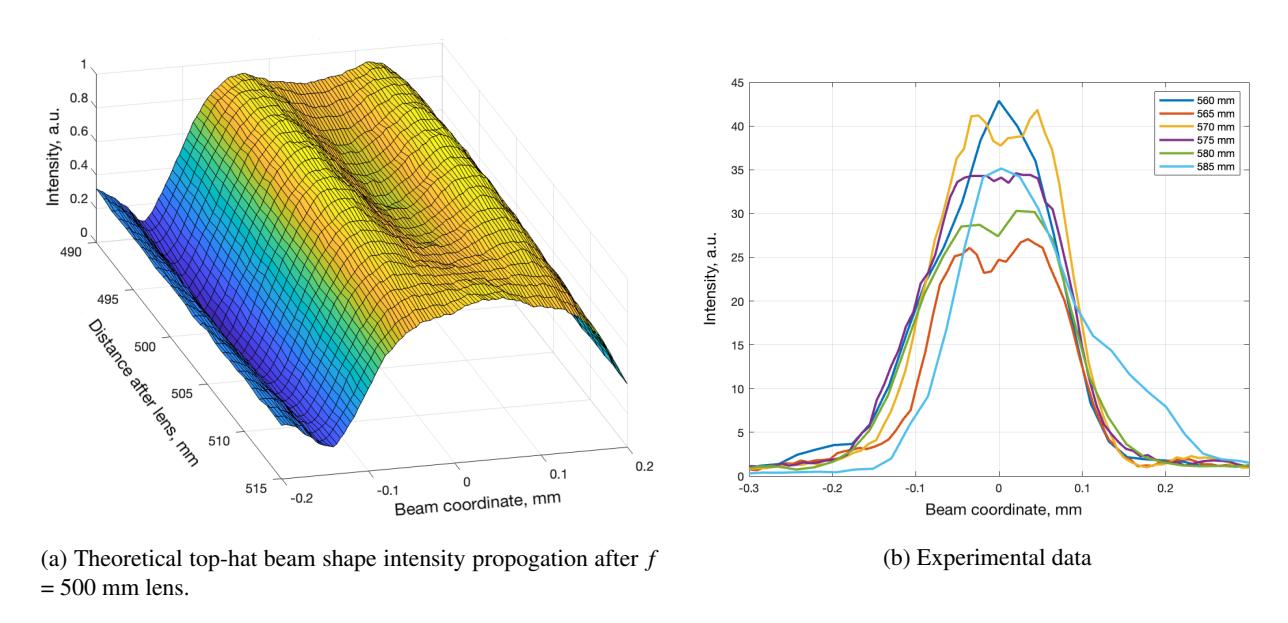
A possible solution might be using binary phase plates, which would cost several EUR/piece and would require little to no adjustments prior to use. In this research a binary phase plate was designed and fabricated from BK glass and was examined both theoretically and experimentally. It was discovered that it is possible to form quasi top-hat beam using a binary phase plate with a square aperture, which introduces a $\lambda$/2 phase shift at certain parts of the Gaussian beam the quasi top-hat beam distribution is maintained along the propagation direction of approximately 0.3 parts of the Raileygh range. The acquired experimental results were comparable with the theoretical data by using diffraction theory.