
In the paper, the preliminary results on the microfluidic platform fabrication equipped with hydrogel matrix are shown. A 3D printing technique was used to provide a "sandwiched" type structure including two different microfluidic substrates. A special attention was paid herein to achieve uniformly bio-printed hydrogel layers of the unique composition and to cross-linking process as well, which properties were then verified by mechanical durability tests. Further investigation concerning the biomedical application of the LOC platform will be done shortly. For instance, the structure will be biologically validated and the magnetic field effects on the selected cancer cell lines will be studied in the context of cells viability and proliferation.
Lab-on-chip devices are so called, miniature laboratories enabling diverse microbiological research to be provided within a single microfluidic chip [1]. They are characterized by substantial reagents minimization, possible automation and high biocompatibility, especially when hydrogel layers are applied. Potential application of LOCs assisted by hydrogel matrix can open the way towards novel anti-cancer therapies and their validation. Planned research includes analysis of the effects of magnetic fields on cancer cells, because there is no clear pattern of cell behavior after exposure to the magnetic field, as reported in studies [2], [3].
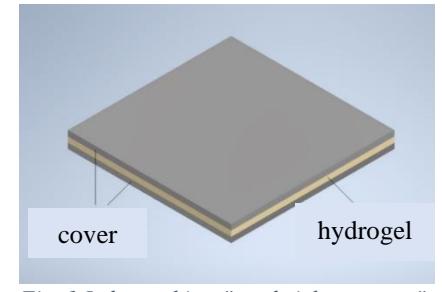
For the microfluidic chip fabrication, the 3D printed substrates (Asiga FusionGRAY V2) were used as a base and a cover of the hydrogel layers. Two different types of hydrogel were manufactured (4% sodium alginate, 2% agar, 1% methylcellulose and 4% sodium alginate, 2% gum arabic, 1% methylcellulose) and applied. The process of bio-print was optimized and deposited layers were in a close relation to the model geometries. Our "sandwich structure" (Fig. 1) was then tested for mechanical durability and results were obtained for parameters, such as Young's modulus, for both hydrogels used. The Young's modulus results for the hydrogels are in the range of 50-60 MPa. These values are similar to the Young's modulus of biological structures (e.g. cornea 3MPa, skin 30MPa) [4].
There are lots of research about impact of the magnetic field on the cancer cells e.g. [2], [3], but it is not connected with LOCs. That is way our future studies are significant. The influence of the static magnetic field on the cancer cells will be identified directly on the cells cultured on LOC and the biological and physical effects (cells viability, proliferation and morphology) will be evaluated in cooperation with Wroclaw Medical University.