1 Department of Physical Chemistry and Technology of Polymers, Silesian University of Technology, Poland
Conductive polymers play an important role in several key technologies, such as printed electronics. For many potential applications, the properties of these materials do not meet the requirements due to the lack of long-range ordering. In the course of research on ${\pi}$-conjugated polymers characterized by ordered structure and high charge mobility, we wanted to investigate the perimidine as a polymerizable unit to obtain organic supramolecular layers which have efficient multi-dimensional electronic delocalization.
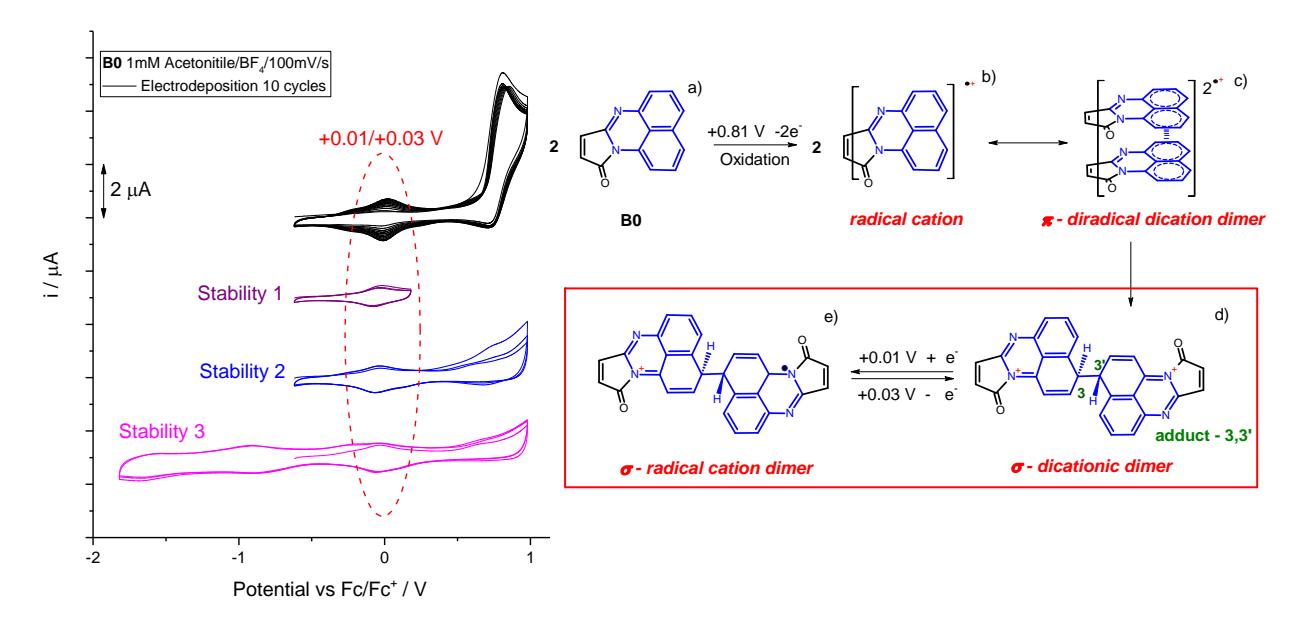
We have already shown in previous publications that the perimidine unit can be electrooxidized to form electroactive products on the electrode surface [1-4]. Going further, we want to show the electrochemical behavior of a missing member from the perinone dyes family. This missing member is compound B0 (Fig. 1), the product formed during condensation reaction of maleic anhydride with 1,8-diaminonaphthale.
The compound we synthesized has been tested electrochemically. It was possible to obtain conductive layers during electrochemical oxidation. Along with computational research, we proposed a mechanism for electropolymerization or dimerization of perimidine units. The obtained layers showed a small bandgap and high stability in a wide range of polarization.
Fig. 1. Electrodeposition cyclicvolamogram of B0 (left); Mechanism of B0 electro-oxidation (right) with stable redoks system d)/e).
Acknowledgments: The work was financially supported by the Silesian University of Technology, grant for young scientists number 04/040/BKM21/0161(BKM-529/RCH4/2021).
[1] M. Czichy, H. Zhylitskaya, P. Zassowski, M. Navakouski, P. Chulkin, P. Janasik, M. Lapkowski, M. Stepien, Electrochemical Polymerization of Pyrrole–Perimidine Hybrids: Low-Band-Gap Materials with High n-Doping Activity, J. Phys. Chem. C 124, 14350–14362 (2020).
[2] M. Czichy, P. Janasik, R. Motyka, P. Zassowski, E. Grabiec, A. Wolinska-Grabczyk, M. Lapkowski, Influence of isomeric phthaloperinone monomers on the formation of ${\pi}$-dimers and ${\sigma}$-bonded segments in electrochemically-crosslinked products, Electrochim. Acta, 137669 (2021).
[3] M. Czichy, R. Motyka, P. Zassowski, E. Grabiec, P. Janasik, A. Brzeczek-Szafran, K. Laba, A. Wolinska-Grabczyk, M. Lapkowski, Effects of solution-phase ordering on the spectroscopic properties and electrooxidative reactivity of isomeric mixtures and isolated isomers of synthesized amidine derivatives, Dye. Pigment. 178, 108309 (2020).
[4] M. Czichy, P. Janasik, P. Wagner, D. L. Officer, M. Lapkowski, Electrochemical and Spectroelectrochemical Studies on the Reactivity of Perimidine–Carbazole–Thiophene Monomers towards the Formation of Multidimensional Macromolecules versus Stable ${\pi}$-Dimeric States, Materials 14, 2167 (2021).