Since the discovery of ferroelectricity (which could be described as electrically switchable spontaneous polarization [1]) in the first half of the 20th century, ferroelectric materials were extensively studied due to their potential application in the areas of pyroelectric detection and imaging, optical memory, electro-optic modulators [2] and large piezoelectricity. Nowadays BaTiO3 (barium titanate - the first inorganic piezoelectric transducer ceramic ever developed) is still widely researched. Very often properties of ceramic material can be improved when substituted with another chemical elements in the lattice [1]. Barium titanate is rarely studied in an original chemical form.
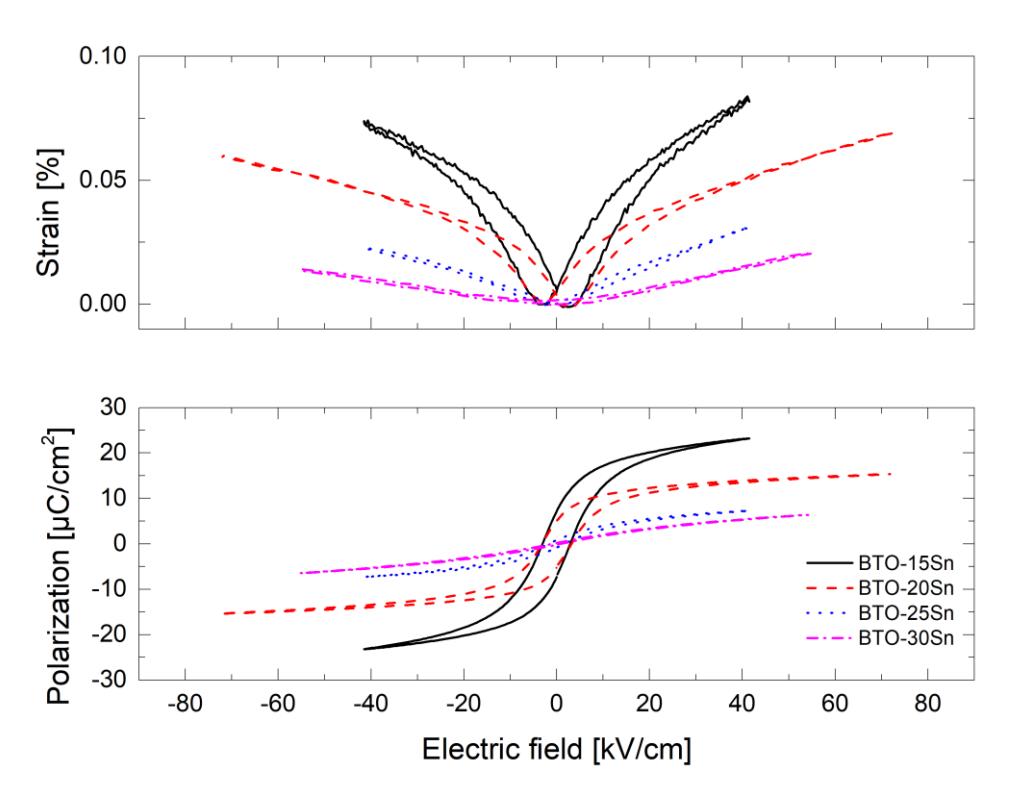
In this work the tin substituted barium titanate (BaTi1-xSnxO3) will be presented. The main goal of this research was to determine the change of dielectric permittivity by altering the concentration of tin, which varied from x = 0.15 to x = 0.30. The research was carried out in the temperature range of 10 – 500 K and 10 Hz – 1 THz frequency region. The majority of experiments focused on dielectric spectroscopy – six methods were used to determine the scalar and complex permeability and refraction coefficients in different frequency ranges. The results were calculated, and the change of dielectric permittivity was analyzed. Additionally, piezoelectric and ferroelectric properties were researched with the use of a commercial AixaCCT TF2000 analyzer. Fig. 1 compares hysteresis loops of barium titanate samples with different concentrations of tin at the temperature of 200 K. The electric field dependence of strain and polarization shown in the figure suggest that BaTi0.85Sn0.15O3 and BaTi0.80Sn0.20O3 have ferroelectric properties, which barium titanate with tin concentrations of 25 and 30 percent lack of. The poster presentation will demonstrate detailed investigation of ferroelectric and dielectric properties of tin doped barium titanate.