
Acinetobacter baumannii is known as a multidrug-resistant (MDR) opportunistic Gram-negative nosocomial pathogen dangerous for patients with critical illness [1]. One of the most important traits responsible for A. baumannii survival in clinical settings is pathogen's ability to form biofilms, which are 10–1000 times more resistant to antibiotic treatment than the planktonic cells [2]. A promising approach to fight MDR planktonic and biofilm bacteria is the antimicrobial photodynamic therapy (aPDT). aPDT is a biophotonic technology based on the interactions of a non-toxic photosensitizer (PS), molecular oxygen and light [3]. After photoexcitation, PS interacts with molecular oxygen and generates reactive oxygen species that initiate cellular damage, thus destroying the bacterial cells. The main goal of the present study was to investigate inactivation of A. baumannii planktonic and biofilm cells by applying riboflavin-based (RF-aPDT) and chlorophyllin-based aPDT (Chl-aPDT).
The LED-based light source for the experiment was constructed at the Institute of Photonics and Nanotechnology (Vilnius University). The 402 nm and 440 nm LEDs were chosen as optimal for Chl and RF photoactivation, respectively. For the inactivation of A. baumannii clinical isolate Ab52, 200 μl of the prepared samples were placed into sterile flat-bottom wells and exposed to the LED light for different periods. The illumination dose (J/cm2) was calculated as irradiance (mW/cm2) multiplied by irradiation time (sec.). The surviving cell populations were counted, the average values were calculated and expressed as log10 (CFU/ml).
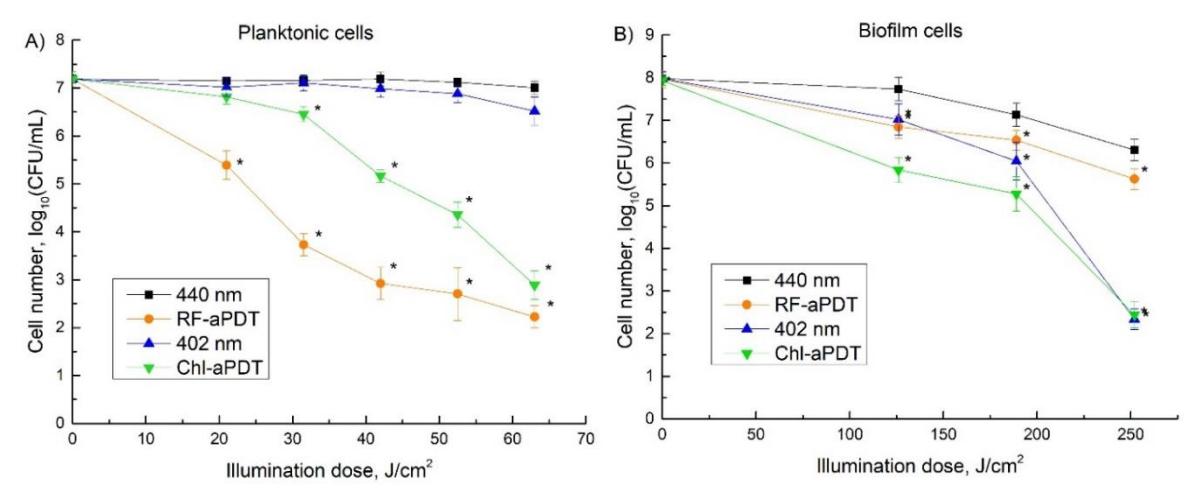
aPDT results showed that A. baumannii planktonic cells were more sensitive to RF-aPDT when the illumination dose varied from 20 J/cm2 to 50 J/cm2 compared to Chl-aPDT. The increase of illumination dose to 63 J/cm2 led to similar sensitivity, where the viability of bacteria after RF-aPDT and Chl-aPDT were diminished by 4.8 log10 and 4.2 log10, respectively (Fig. 1A). On the contrary, the biofilm cells were more efficiently inactivated by Chl-aPDT (reduction by 5.5 log10) than RF-aPDT (inactivation by 2.35 log10) when the illumination dose was 252 J/cm2 (Fig. 1B). However, 402 nm LED light without PS (252 J/cm2) dramatically reduced viability of biofilm cells, A. baumannii CFU number decreased by 5.6 log10. In summary, RF-aPDT and Chl-aPDT can be used as a potential means for A. baumannii inactivation, both planktonic and biofilm cells.