Computed tomography (CT) is an indispensable imaging technique used in everyday medical practice. While main drawback of CT has always been ionizing radiation, until the last few decades it was a manageable problem with infrequent imaging and single scans. Nowadays, CT makes up only 9,6% of all radiology procedures, but up to 61,6% of all effective doses (ED) received [1], as more and more patients get large cumulative effective doses (CED) of 100 mSv and more, in short periods of time (1-5 years) [2]. The currently accepted risk model about radiation induced cancer is linear non-threshold (LNT), which states that even the smallest doses can increase the risk of cancer [3]. Taking LNT into consideration, the large CED being received by increasing amounts of patients getting CTs are very concerning [4].
The aim of this study was to analyze current literature about health risks posed by cumulative exposure and available methods of minimizing high doses without losing diagnostic value of the images, as well as to retrospectively evaluate cumulative exposure of a group of patients from a hospital in Lithuania.
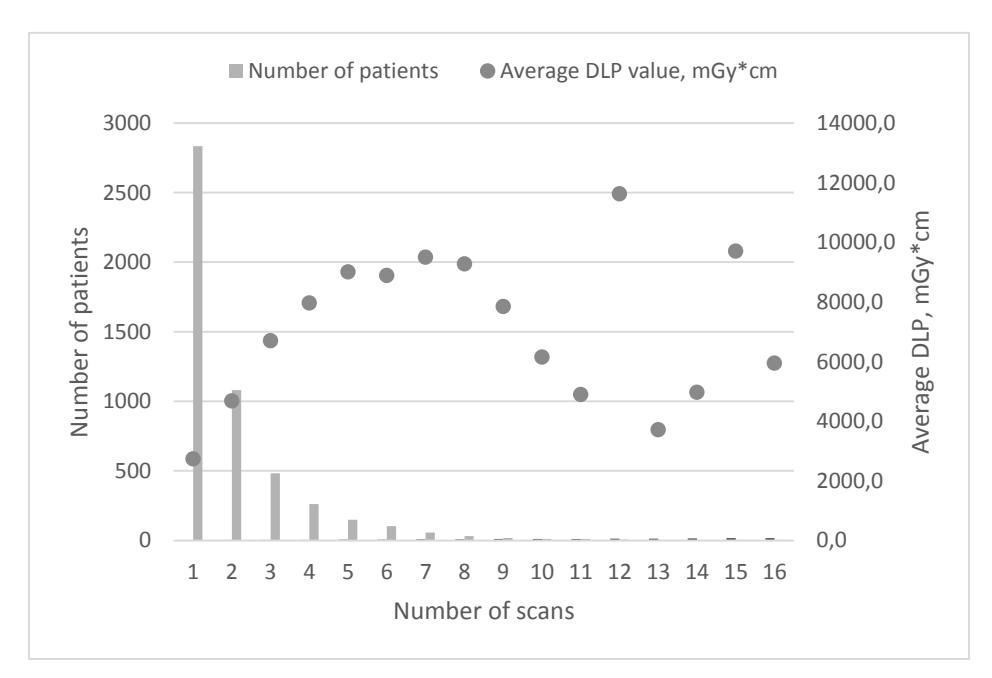
From January, 2019 to December, 2021, CT imaging data of 30,313 patients from a single hospital was collected. 5,060 (16,7% of all) patients who have received multiple (varying between 2 and 18) CT procedures were selected for this study. The majority of patients received 2 scans (9,3% of all), while only 0,83% received 7 or more scans. Lowest cumulative doses were of those having received 2 scans (average 2731,6 mGy*cm; max 21948 mGy*cm), the highest of those having received 13 scans (average 11620,4 mGy*cm; max 42533 mGy*cm). On average, it was estimated that recurrent scans of 3 and more had an average ED above 50 mSv. Information from recent literature and research provides strong evidence for higher cancer risks in patients who have received above 100 mSv ED, and good evidence for doses above 50 mSv [4].