Laccases are multi-copper oxidases (EC 1.10.3.2), containing T1, T2 and T3 copper sites. Thought the years of investigating various laccases, a lot of information has already been accumulated: catalytic mechanism, redox potentials, enzyme sources, reorganization energies. These enzymes catalyze a unique oxidation of phenols, aromatic amines and thiols by using oxygen as a co-substrate and produce water as a by-product.[1] This process has an enormous potential for food, textile, paper, biofuel, cosmetics, paints, furniture industries and organic synthesis, nanobiotechnology and bioremediation.[2] By employing laccase-mediator systems, and thus expanding their substrate spectrum they could replace hydrogen peroxide and other chemical oxidators at industrial scale. However, tangible application of laccases is hindered by the unresolved drawbacks such as poor stability, commercial unavailability, lack of efficient expression systems, low immobilization yields, etc.
One of the shortcomings for discovering laccases with new and/or novel features is a lack of substrates suitable for high-throughput screening and functional analysis. Currently, the most common compounds used for laccase functional analysis are 2,2'-azino-bis(3-ethylbenzothiazoline-6-sulphonic acid) under the trivial name ABTS and 4-[[2-[(3,5-dimethoxy-4-oxocyclohexa-2,5-dien-1-ylidene)methyl]hydrazinyl]methylidene]-2,6-dimethoxycyclohexa-2,5-dien-1-one known as syringaldazine.[3,4] Spectrophotometric activity assays with these substrates give acceptable results, but these compounds have poor stability, low specificity and are rather expensive. Their use for high-throughput screening on agar plates is very hindered due to their thermal and pH instabilities.
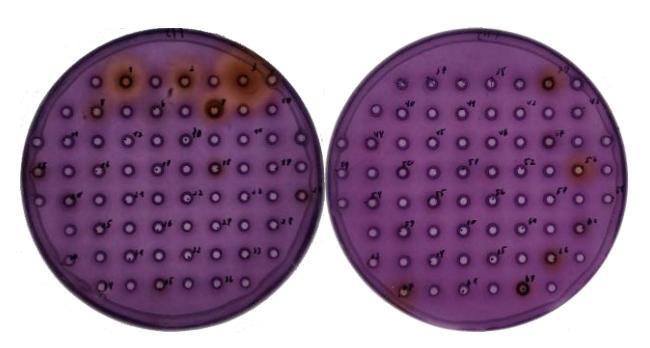
By our investigation, we present a new substrate named Ferbamine for laccase activity screening on high-throughput agar-plates. Its thermal and pH stability in aqueous buffer solutions were studied. The latter substrate toxicity for Kluyveromyces marxianus, Kluyveromyces lactis, Saccharomyces cerevisiae and Pichia pastoris strains were investigated. Furthermore, Ferbamanine was tested on substrate-agar plates with commercially available laccase Novozym 51003 from Aspergillus oryzea and with the collection of wild fungi protein extracts provided by Jožef Stefan Institute (Fig. 1) [5].