Iron is an essential nutrient that helps the body perform many daily functions. One of the main functions of iron is to carry oxygen through the blood. Iron deficiency is the most prevalent cause of anemia. On the other hand, excess iron can harm human health by increasing free radicals, leading to renal failure, liver damage, or even death [1].
Iron ions naturally exist in all types of rocks, soil, and water. Because the iron salts can be washed away, the water is typically rich in iron, which not only influences the entry of iron ions into the human body but also changes the flavor of the water. Therefore, it is very important to develop a simple, sensitive, and reliable method for binding iron ions [2].
Many methods have been developed to detect different ions in water (atomic absorption spectrometry, inductively coupled plasma mass spectroscopy, electrochemical methods), but they often require complex sample preparation and advanced instruments. Due to its low cost and ease of management, the colorimetric method has received considerable attention in recent years [3].
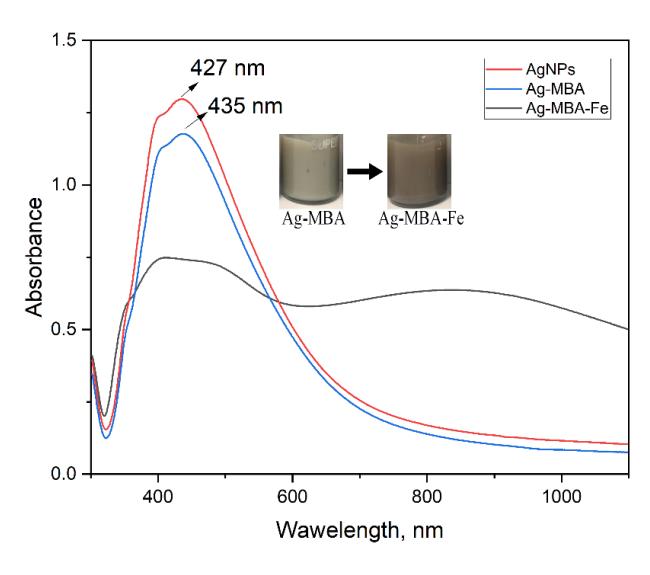
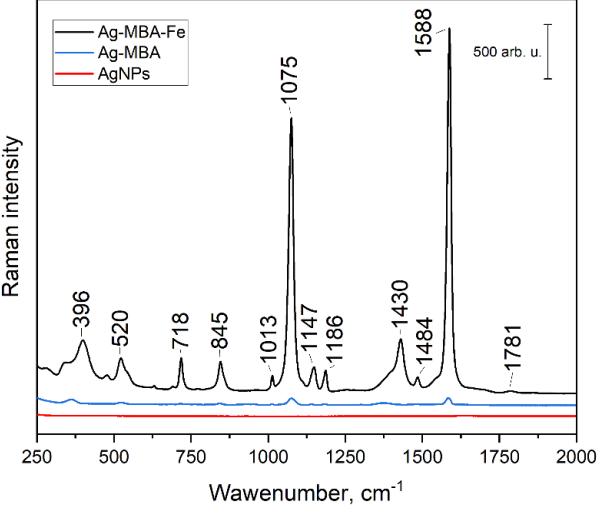
Synthesized by chemical reduction silver nanoparticles (AgNPs) were subsequently functionalized with 4-mercaptobenzoic acid (MBA) and used for Fe2+ detection. Modified nanoparticles (Ag-MBA) aggregate in the presence of Fe2+. The binding of ions to aggregates can be monitored by different methods. We combine UV-Vis and SERS techniques. The formation of the aggregated complex (Ag-MBA-Fe) was detected by visible color exchange (from greenish-gray to brownish-gray) and UV-Vis absorption spectra (Fig. 1). We also succeeded in recording the SERS spectrum of the Ag-MBA-Fe complex (Fig. 2). The concentration of iron ions in water used in our work was 10-3 M, but we have reason to believe that the detection limits may be lower.