Stilbene is a diarylethene group compound, that has aromatic groups bonded to the carbon – carbon double bond. This group compounds are known due to their sensitivity, therefore they are suitable for molecular switches or sensors [1]. Because of this property, stilbenes are already applied for ionized radiation detectors [2]. However, the main characteristic of stilbene is reversible cis – trans isomerisation. That makes stilbene a great model for molecular rotary motors [3]. During isomerisation, there is a twisting of phenyl rings around single carbon – carbon bond in stilbene molecule. The potential energy dependence on the twisting angle between two phenyl rings indicates the potential minimum at 90° twist. Moreover, it shows that isomerisation from the trans to cis form is more complicated due to the existing barrier in first excited state [1].
In this study, we determined fluorescence spectra of heterostructured trans-stilbene and its films in polystyrene matrix with different concentrations. The samples were made by using a spin-coating technique. Steady – state photoluminescence spectra and its decay kinetics were measured using a time-correlated single photon counting spectrophotometer. For sample excitation picosecond pulsed laser diode EPLED – 300 was used.
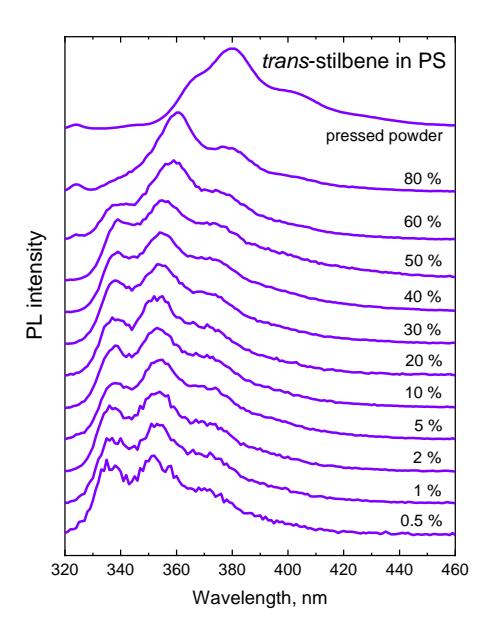
Although there is no isomerisation of trans-stilbene in polystyrene matrix, by varying the concentration, aggregates may cause the changes of spectroscopic properties. The increase of trans-stilbene concentration resulted in the red shift and broadening of fluorescence spectral bands (Fig.1). At low concentrations, spectral bands are narrow due to the excitation of separated molecules. The increase of concentration results in the creation of dimers and leads to shorter relaxation times.