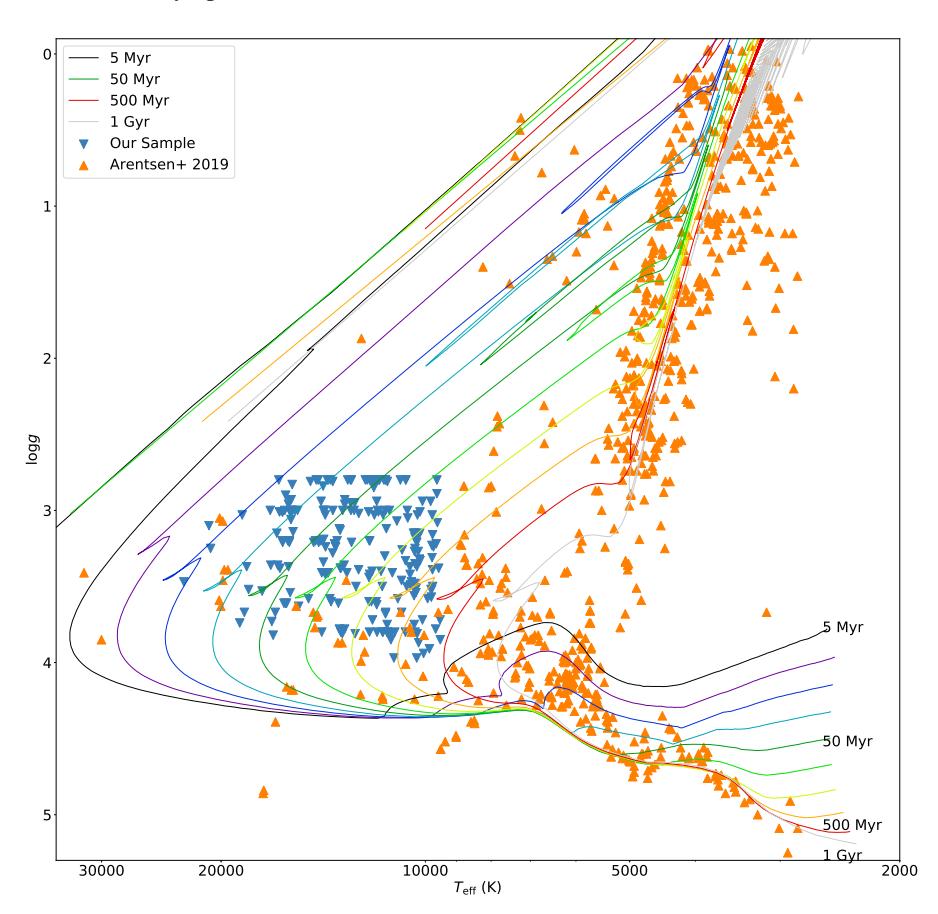
Stellar population models are building blocks for furthering our understanding of galaxies. With short lifetimes and high bolometric luminosities, B-type stars dominate the first few to tens of Myr of a stellar population, and strongly influence the chemical evolution of their environment via nucleosynthesis of metals and supernovae explosions. Currently, empirical spectral libraries such as the X-shooter Spectral Library (XSL) have a paucity of these stars compared to cooler stars, making it difficult to probe younger populations. We use the MIDE3700 code to find effective temperatures $T_{\rm eff}$ and surface gravities $\log g$ via the BCD method for 222 B-type stars in the XSL calibration archive in preparation for their inclusion as an extension to the XSL itself. We find agreement to within $\sim 0.1\sigma \log T_{\rm eff}$ and $\sim 0.25\sigma \log g$ between our results and a sample of literature stars. As can be seen in Figure 1, we populate a previously bare region of the XSL Hertzsprung-Russell diagram in the ranges $9000 \le T_{\rm eff} \le 23000$ and $2.8 < \log g \le 4.0$, and extend the lower age limit for XSL stellar population models by up to a factor $\sim 10$ for [Fe/H] = -1.2, and a factor $\sim 2$ for Solar metallicity.