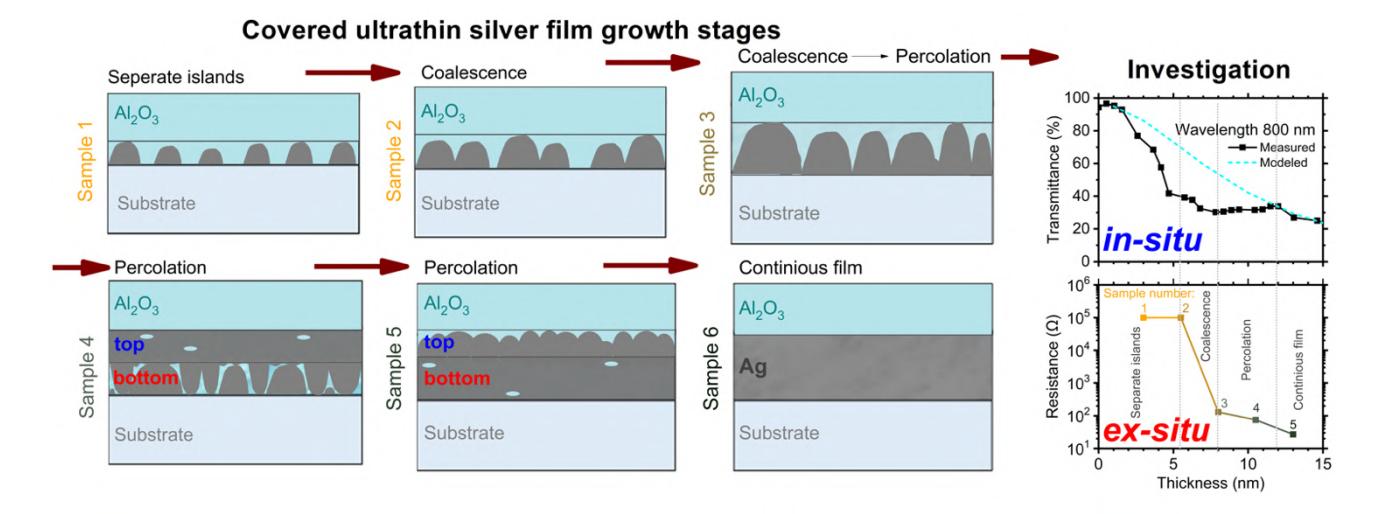
In recent study [1], we compare in-situ transmittance and plasma emission spectra with ex-situ resistance and ellipsometric measurements performed on ultrathin silver films with thicknesses varying from 3 nm through 40 nm and on relatively thick layers up to 100 nm.
We show that the transmittance broadband monitoring (BBM) of the growing silver layer allows for in-situ reliable estimation of the minimum thickness when the film becomes continuous. Moreover, a proper selection of the monitoring wavelength(s) renders the coalescence and percolation stages of the film growth clearly distinguishable.
For our films deposited by magnetron sputtering on fused silica substrates, the minimum thickness when a film becomes continuous was found to be approximately 12 nm. The percolation threshold was determined as approximately 6 nm. The method of selective-wavelength transmittance BBM is practical, intuitive and hence may represent a useful tool enabling high-precision growth of ultrathin silver layers.
Furthermore, we show here for the first time that ellipsometry is sensitive to the metal coalescence development. In particular, the ellipsometric analysis suggests that the percolation of silver sputtered films begins at the top of the growing layer and hence propagates towards the film bottom.