
Budding yeast Saccharomyces cerevisiae are very important for the food industry, they are used to produce fermented food and drinks. Yeast cells are also often used as a model eukaryotic organism to investigate cellular responses to abiotic conditions [1]. One of the prospective abiotic treatments suggesting a wide range of applications and effects which depend on pulse duration and its strength is the pulsed electric field (PEF). When compared to electric field pulses with microsecond duration, nanosecond pulsed electric field (nsPEF) has a greater impact on intracellular structures and cells' functions [2]. nsPEF changes cells' intracellular environment by damaging organelles and membranes, still, it is not clear how the cell reacts to occurred changes and what mechanisms are activated [3]. Besides lethal effects, sub-lethal injuries can occur, which lead to a loss of ability to grow on selective media [4]. This study aims to investigate nsPEF effects on yeast cells' viability, occurred sub-lethal injuries caused by different pulse strength and a number of pulses.
Cells were collected in the early exponential phase at 0.9 – 1.1 OD600, washed twice with electroporation buffer (EPB) and suspended in 1 mL EPB. Cells were exposured to 1, 3 and 5 impulses of 90 ns, with strengths of up to 250 kV/cm. The viability of cells was evaluated by counting colony-forming units on YPD and selective medium (YPD + 2% NaCl) (Fig. 1. A). Also, programmed cells death, dependent on metacaspase activation was evaluated using caspase detective FITC-VAD-FMK marker. Caspase detection assay was performed according to the producer protocols and YCA1+ metacaspase was evaluated using flow cytometer (Fig.1. B).
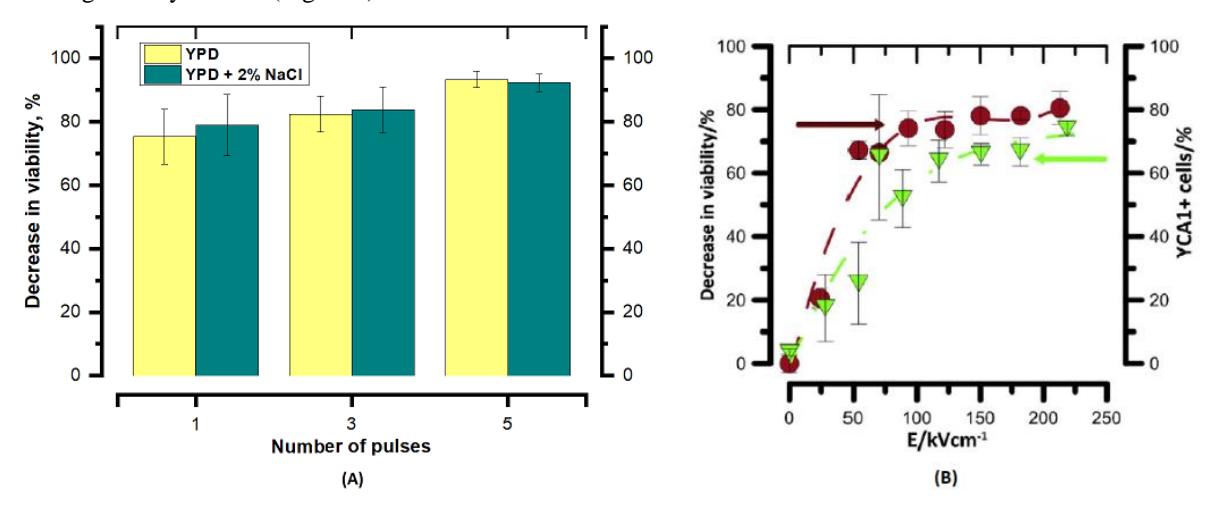
This study showed that cell viability is dependent on number of nanosecond pulsed electric field pulses and field strength, which cause lethal or sub-lethal injuries. We think, that cell viability decrease on selective media the same as on non-selective media, because nsPEF has a greater impact on intracellular environment than on cells' membrane. We also see that after nsPEF treatment metacaspase activity increase and result in metacaspase/dependent programmed cells death [5]. We assume that because of these intracellular changes after treatment with nsPEF yeast cells can not repair damaged organelles and membranes become permeable.
The prospect of this research is analyze how nsPEF damages cell organeles, such as mitochondria, how sub-lethal injuries affect death patterns and what reparation mechanisms work depending on type of induced damage.