
A new coordination polymer, {[Zn(HL)2] x 4 DMF}n, has been synthesized under mild solvothermal conditions by the reaction of ZnCl2 with ligand 2,2'-diaminobiphenyl-4,4'-dicarboxylic acid in presence of formic acid, in N,N-dimethylformamide (DMF) at 100 °C for 48 h. The colorless needle-shaped single crystals thus obtained were suitable for X-ray crystallographic measurements. The compound was additionally characterized by IR spectroscopy.
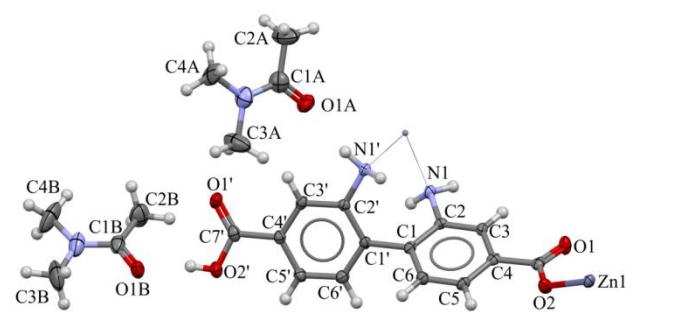
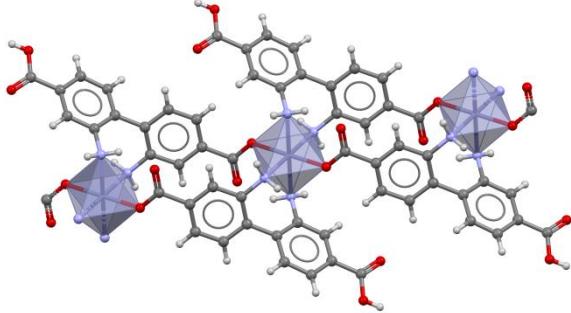
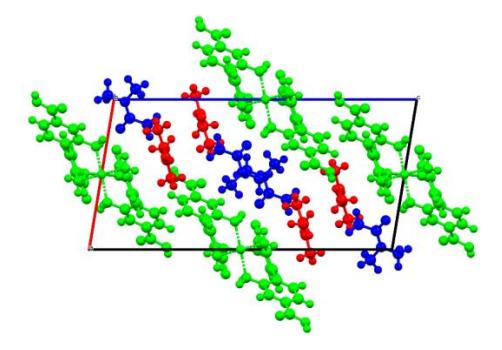
The asymmetric unit (Fig. 1) is composed of one Zn(II) atom, one ligand molecule and two uncoordinated DMF molecules. Ligand is coordinated in a monoanionic form as ONN tridentate, and acts as a bridging ligand linking two atoms of Zn(II). To one Zn(II) atom the ligand is coordinated through oxygen atom from deprotonated carboxylic group, while it binds second Zn(II) atom through both amino nitrogen atoms, thus forming a seven-membered chelating ring (Fig. 2). Each Zn(II) is coordinated by four nitrogen atoms that form the equatorial plane and two oxygen atoms that occupy the axial positions of the octahedrally shaped coordination polyhedron. The slightly distorted octahedral environment is indicated by different bond lengths as equatorial bonds Zn1–N1 [2.183(2) Å], and Zn1–N1' [2.189(3) Å] are significantly longer than the axial Zn1–O2 [2.0817(19) Å] bond. Coordination polymer molecules extend along the b-axis direction and form layers parallel to the (–1 0 1) plane, while interleaved are layers filed with molecules of DMF (Fig. 3). Interlayer hydrogen bonds are observed between DMF and ligand molecules.
The data were collected on Gemini R Ultra (Oxford Diffraction) using Mo Kα radiation. The structure was solved using SHELXT [1] and refined by full matrix least square methods on $F^{2}$ using SHELXL [2] and ShelXle as a graphical user interface [3]. Crystallographic data: C44H58N8O12Zn, Mr = 956.36, monoclinic crystal system, space group P21/n, a = 11.3914 (13) Å, b = 8.8086 (6) Å, c = 22.691 (3) Å, β = 99.388 (11)°, V = 2246.3 (4) Å3, Z = 2, R = 0.053, wR($F^{2}$) = 0.113, S = 1.04, for 303 parameters and 4574 reflections.