The caffeoylquinic acid (CQ) derivatives, esters of caffeic and quinic acids, are the main phenolic compounds in green coffee bean (GCBE) and artichoke (AE) extracts. These phenolic compounds are known to have numerous biological activities such as antifungal, antioxidant or antimicrobial. However, the application of CQ derivatives is limited by its low bioavailability, high vulnerability to oxygen or thermal processing. To overcome these disadvantages, water insoluble complexes have been formed between chitosan (ChS) and CQ derivatives present in AE and GCBE by the equilibrium adsorption method.
In the present study, the bioactive properties such as antioxidant and antifungal activities of water insoluble complexes of ChS and phenolic compounds such as CQ, present in GCBE and AE, have been investigated.
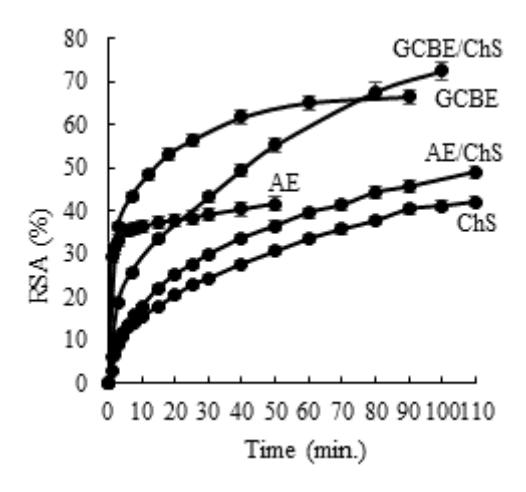
The antioxidant activity of AE/ChS and GCBE/ChS was evaluated by the ABTS•+ method, and expressed as time dependent ABTS•+ radical scavenging activity (RSA, %) (Fig. 1). The antioxidant activity of phenolic compounds attached to ChS is higher in comparison with antioxidant activity of AE and GCBE. Moreover, AE/ChS and GCBE/ChS powders exhibited the prolonged radical scavenging. It should be noted that chitosan itself possesses good antioxidant activity due to its unique properties and this also effects activity of the complexes.
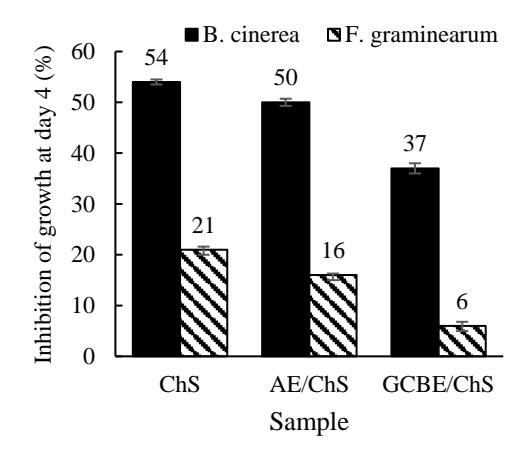
Antifungal activity of AE/ChS and GCBE/ChS was evaluated by growth inhibition bioassay against two fungi i.e. F. graminearum and B. cinerea (Fig. 2). ChS was used for comparison. The growth of both fungi was reduced by using AE/ChS and GCBE/ChS complexes, however calculated inhibition of growth values were lower than those determined for ChS powder. This could indicate that CQ derivatives adsorbed on ChS may increase the growth of both fungi to some extent.