
As aquaculture industry grows, microalgae could be used for the bioremediation of its wastewater. This is in accordance with principals of circular economy, since these microalgae clean wastewater and synthesize highly valuable compounds at the same time. One of the most effective methods to extract these compounds is high-pressure homogenization technology. However, different fractions of algae compounds are mixed during this process, thus there is a need for an additional purification step. Therefore, other effective extraction methods are investigated [1].
Pulsed electric fields (PEF) is an intensively researched extraction method. It is based on usage of short (μs-ms) and strong (5-80 kV/cm) electric pulses, which cause an increase of cell membrane permeability. Advantages of this method are selectiveness and purity of extracted substances [2]. Nevertheless, extraction with PEF isn't effective enough, hence researchers are trying to improve it. Cold plasma treatment could possibly be a solution. During the treatment, generated radicals may cause lipid oxidation, leading to membrane weakening and pore formation [3]. A combination of these techniques could be useful strategy to increase extraction yields of valuable compounds from microalgae. Moreover, they could be adapted to an industrial scale.
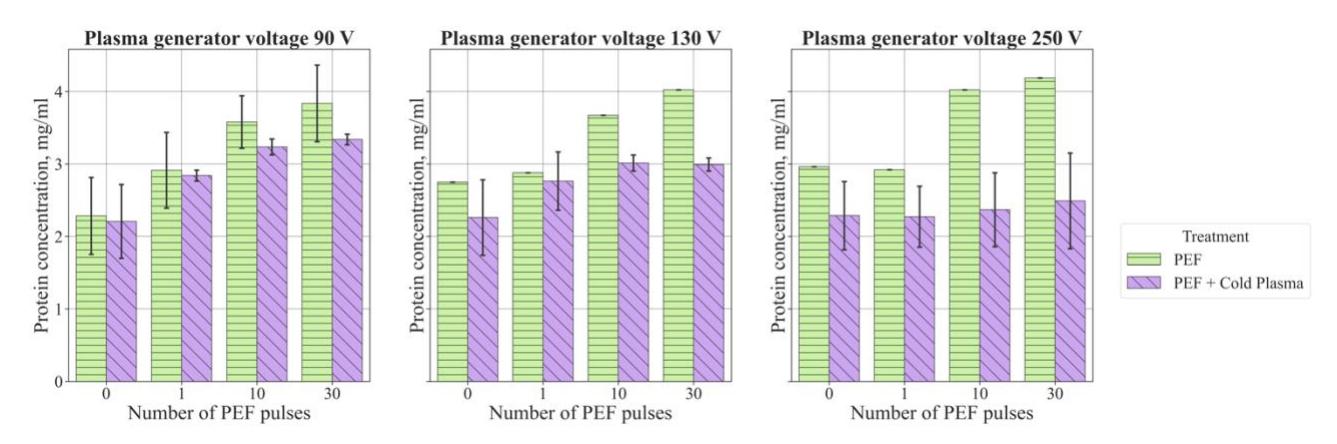
For protein extraction experiments, suspension of Chlorella vulgaris microalgae was washed once and concentrated up to 100 g/L wet biomass with BG-11 medium (${\sigma}$ = 1,96 mS/cm). Then they were treated with cold plasma or PEF only, or firstly by cold plasma and then by PEF. Cold plasma treatment lasted for 5 minutes, and plasma generator voltages were 90 - 250 V. PEF parameters were U = 3,5 kV, t = 10 μs, f = 1 Hz, n = 1;10;30, d = 0,1 cm. Conductivity of the suspensions was measured after cold plasma treatment. Further, after selected treatment, samples were incubated for 2h at room temperature. Finally, protein concentration in the supernatant was determined with Bradford method.
Firstly, conductivity changes were observed after cold plasma treatment – there was an increase of it in microalgae suspensions. For instance, after treatment with plasma generator voltage of 250 V, suspension's conductivity has risen by 52%. This indicates that cells' membranes were permeabilized. Additionally, when samples were treated with a combination of cold plasma and PEF (plasma generator voltage 90 V, n (PEF) = 1; 10; 30), protein extraction has increased, compared to only plasma treatment control. However, the results (Fig. 1) have shown that PEF alone is more efficient for protein extraction than combination of PEF and cold plasma. For example, obtained protein concentrations after PEF (n = 10) and cold plasma + PEF (plasma generator voltage 90 V, PEF n =10) treatments were respectively 3,58 ${\pm}$ 0,51 mg/ml and 3,24 ${\pm}$ 0,15 mg/ml. After PEF (n = 10) and cold plasma + PEF (plasma generator voltage 250 V, n (PEF) =10), the results were accordingly 4,02 mg/ml and 2,37 ${\pm}$ 0,72 mg/ml. Therefore, further investigation on how cold plasma and PEF together affect microalgae cells is needed.