
The history of 3D printing starts back in the 1920s when the fundamental perception of polymers was understood. Then the golden age of polymers started. Many scientists tried various ways for synthesizing polymers commercially [1]. DuPont company was a pioneer in synthesizing first photosensitive materials (photopolymers). The invention of light-emitting diodes (LED) was a boost for creating the first commercial 3D printer. The first 3D printing technology worked based on layer-by-layer fabrication technology. Nowadays we count various 3D printing methods [2].
In this work we present the results of printed Ignalina Nuclear Power Plant (IAE) model. Below in Fig. 1 a) part we see a picture of a real IAE which is then digitalized in Fig. 1 b) part. We depict results from our experiments using desktop digital light processing stereolithography (DLP-SLA) 3D printer (Fig. 1 c) part) and direct laser writing (DLW) system (Fig. 1 d) part). The DLP-SLA printing technology consists of a UV light source in our case laser diode with a 405 nm wavelength and a semiconductor digital micro-mirror device (DMD) [3]. DLP-SLA printing technology possess a fixed matrix of pixels on a building area. The IAE model was printed with Asiga Pico 2 DLP-SLA printer with an ability to reach approximately 40 μm feature size. This is perfect for printing objects in cm/mm dimensions (used in dental implants), but to reach μm we need to move from a single photon absorption (SPA) to two photon absorption (TPA). TPA mechanism consists of simultaneously absorbing two photons and initiating the transit of molecules to a higher energy level. The cross section of TPA mechanisms is smaller compared with SPA and the result we see in Fig. 1 d) part: our printed object's dimensions are [300×300×200] μm3 [4].
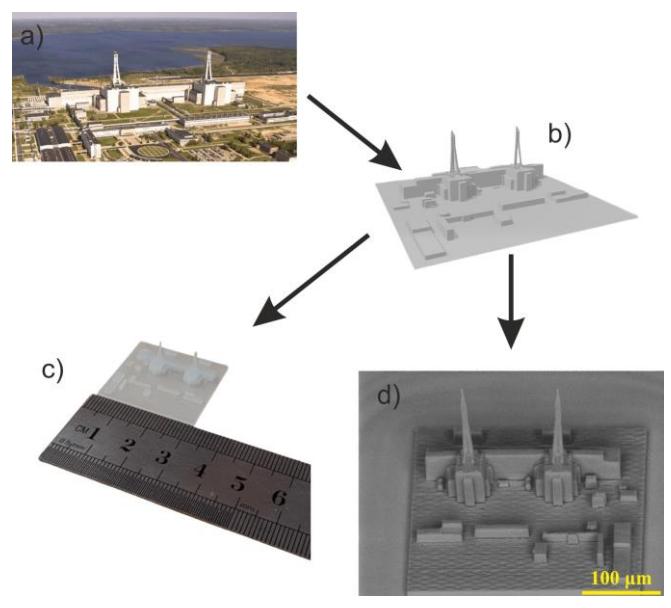
Experiments showed that DLP-SLA printer allows us to print 3D objects in centimeters and DLW system in micro-meter dimensions. Photon absorption is a probability. For DLW system the probability to absorb two photons is very low. This is the reason why polymerization starts only in laser focused place.