
The linear absorption spectrum of H and J molecular aggregates, where both the electronic and vibrational molecular degrees of freedom are considered. It is made up of a collection of molecules (sites) coupled via an electrostatic dipole-dipole interaction. Intramolecular vibrational modes are modeled as harmonic oscillators. Molecular aggregate excitation dynamics and spectra can be computed using the wavefunction based time-dependent Dirac-Frenkel variational principle by postulating an Ansatz wavefunction, which ought to be complex enough to represent all the necesary electron-vibrational quantum states of the aggregate.
Vibronic states can be represented using the multi-Davydov D2 (mD2) Ansatz [1], given by
$$|\Psi_{\text{mD}_2}(t)\rangle = \sum_{m=1}^{M} \sum_{n} \alpha_{i,n}(t) |n\rangle \otimes |\boldsymbol{\lambda}_m(t)\rangle$$\tag{1}where $|n\rangle = |1_n\rangle \bigotimes_{m\neq n} |0_m\rangle$ is an electronic state with amplitude $\alpha_n(t)$, which define a singly excited nth site. Intramolecular vibrational mode state is represented in terms of the multidimensional time-dependent coherent states $|\boldsymbol{\lambda}_m(t)\rangle = \bigotimes_{k,q} |\lambda_{m,kq}(t)\rangle$, where $|\lambda_{m,kq}(t)\rangle$ is an mth coherent state multiple of a qth mode coupled to the kth site. By consider a sufficient number of multiples M, Dirac-Frenkel variational method with mD2 Ansatz can match accuracy of the Hierarchical Equations of Motion and Multi Configuration Time Dependent Hartree methods [2].
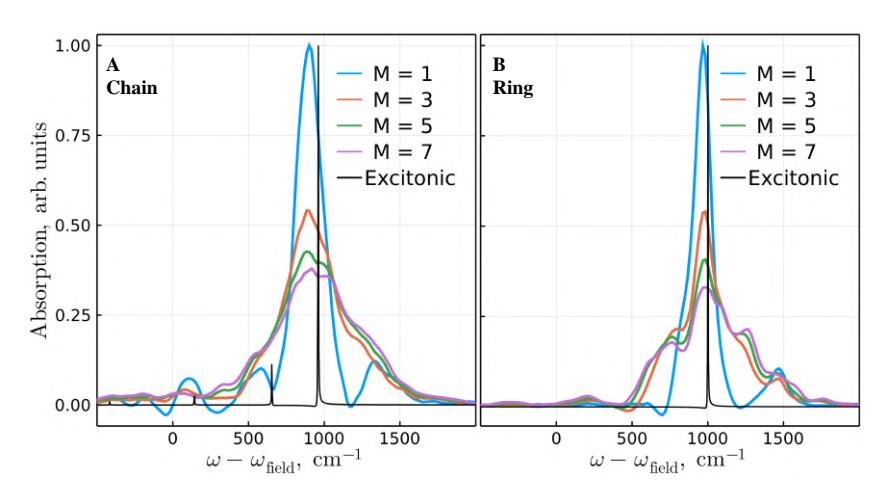
By inspecting and comparing absorption spectra of both the ring and chain aggregates over a range of electrostatic nearest neighbor coupling and temperature values, we find the mD2 Ansatz with multiplicity of M=7 is required to obtain accurate aggregate absorption spectrum, while the regular D2 Ansatz (Eq. (1) with M=1) is not sufficient. For H aggregates, see Fig. (1), multiplicity is required to obtain absorption lineshape positivity and correct peak intensities. For J aggregates, increasing the number of multiples considered, mostly just redshifts whole absorption spectrum, keeping the overall lineshape qualitatively the same, especially in ring aggregate. Due to vibronic energy level structure of an aggregate, vibrational mode coordinate and momentum variances exhibit out-of-phase oscillatory behaviour and an overall wavepacket broadening, which again is not captured by the non-multiple D2 Ansatz.