Electron Paramagnetic Resonance (EPR) is a broadly used technique to study and manipulate electron spins across different disciplines covering quantum information, material science, physics and biology. However, in conventional EPR spectroscopy, sensitivity often limits the range and type of systems that can be studied. Recently, major advances in EPR sensitivity were achieved using planar superconducting microresonators [1,2]. However, these applications were limited to very low temperatures and spins in substrates of the resonators severely limiting the applicability of such resonators for conventional EPR samples. Thus, the full potential and compatibility of such microresonators to study a more general spin systems remains to be shown, which requires solving of several problems such as a convenient coupling to the driving microwave field.
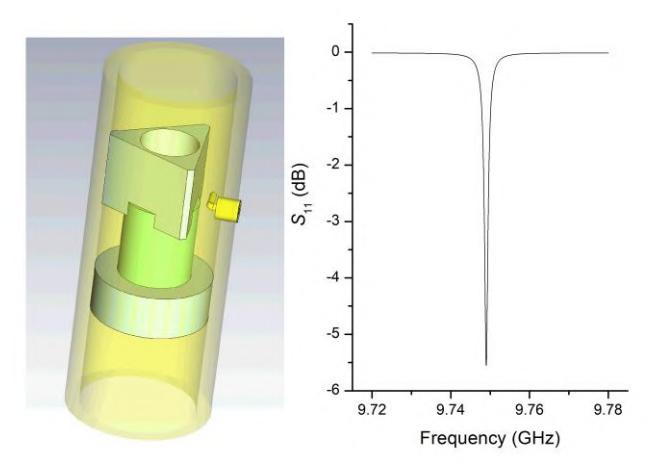
Here, we explore the feasibility of microwave coupling to a planar EPR microresonator using a standard 3D cavity. First, we use CST Microwave Studio computational electromagnetics tool to simulate frequency response of a Bruker MD-5 dielectric ring resonator (Fig. 1). Our simulations successfully reproduce the resonance frequency of about 9.75 GHz of the TE01δ mode of the resonator, which is revealed in the calculated frequency response of the S11 scattering parameter (Fig. 1). Then we use this model as a basis to simulate microwave coupling to a planar microresonator placed into an EPR tube, which is then inserted into the dielectric ring resonator. We compare our simulation results with the experimental observations and further discuss the best coupling geometry.