
In modern ground-based optical astronomy, Adaptive Optics (AO) plays an important role minimising strong effects (e.g. wind influence [1], temperature fluctuations [2], light interaction with particles [3] and etc.) that comes from the atmosphere. Nowadays, all largest ground-based optical telescopes are equipped with single or multiple AO systems that corrects perturbed photon wavefront coming from desired astronomical object to an almost ideal diffraction pattern with a clear visible Airy disk [4]. This makes a good job for astronomers to obtain high-resolution images and detect faint objects or not clearly resolvable parameters.
For the time being, exploration of Black Holes (BHs) is a hot topic among astronomers. It is believed that dozens of stellar mass BHs are found in the binary systems [5] but isolated BHs are far beyond the detection limits. Detecting isolated BHs will help scientists to perform theoretical predictions and modelling of stellar evolution [6].
For this purpose, Gravitational Microlensing Phenomenon [7] comes to hand because it is very powerful method on detecting isolated BHs. It was first described by Albert Einstein relying on the General Relativity Theory. By a reson of a massive object (a lensing star), which is passing in front of the background star, the coming light wavefront is bend and the magnification is observed [8]. After many years, lens and a star move away and can be observed separately [9]. This means that not detecting a luminous lens, we can still investigate constrains on the black holes nature [10].
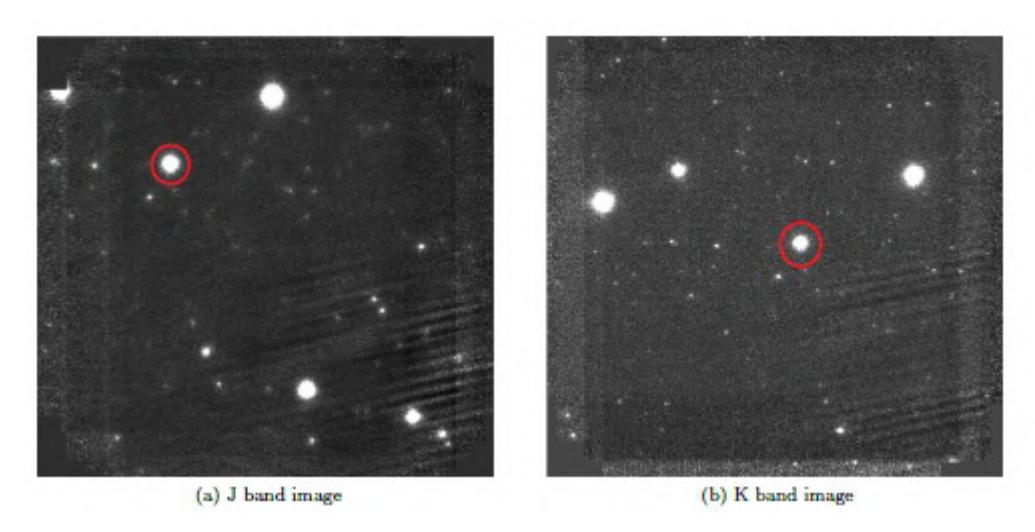
In this research, we analyse two images of target star OGLE3-ULENS-PAR-2 that are showed in red circles at (Fig. 1). Images at J and K-bands were taken by NaCo AO system ((NAOS CONICA) Nasmyth Adaptive Optics System Near-Infrared Imager and Spectrograph instrument) which was mounted on 8.2 m Very Large Telescope (VLT) observatory.
In conclusion, by analysing the Point Spread Function of the target star in junction with the reference stars, we detect no additional light. This means that lens can be dark or relative proper motion is very small.