
β-blockers are pharmaceuticals prescribed for cardiovascular diseases and treating various disorders such as hypertension (high blood pressure), angina, and arrhythmias [1]. Nadolol is a commonly used β-blockers whose percentage excreted in urine is 24.6% [2]. Due to its ubiquitous occurrence and toxicity to aquatic organisms, it is crucial to determine its photochemical fate and stability in water.
For each pollutant, abiotic processes in surface waters include hydrolysis and photolysis. The nadolol hydrolysis was investigated in ultrapure water at 25 ± 1 °C in the dark. Also, direct and indirect photolysis of nadolol was investigated under different irradiation (Fig. 1, under simulated solar (SS), UV-LED and UV irradiations).
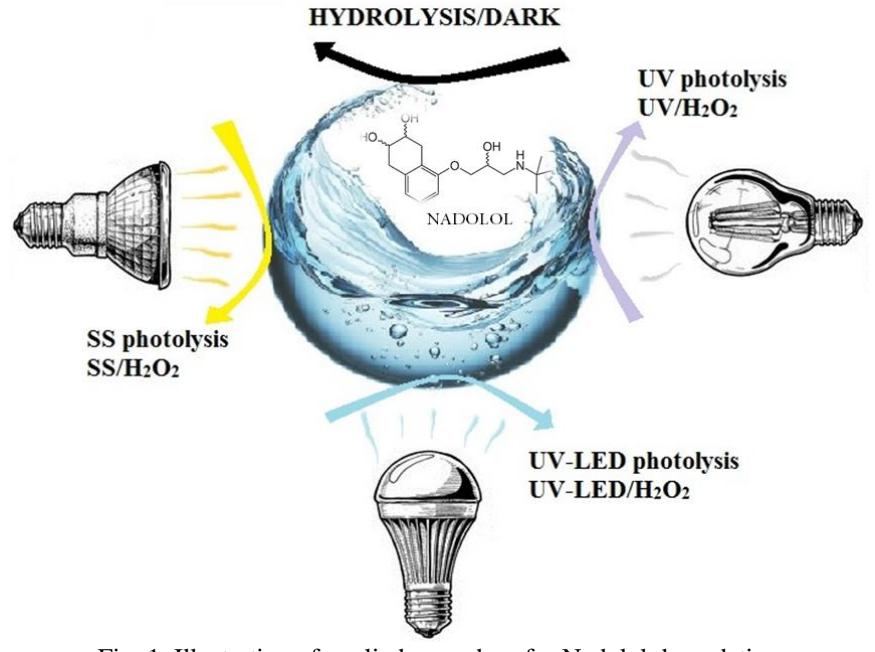
Hydrolysis didn't significantly remove nadolol from aqueous solutions at 8.5 pH value. The stability of nadolol in water is a primary reason why it is detected in environmental waters [3]. For efficient direct photolysis to occur, there must be an appropriate overlap between the absorption spectrum of the nadolol and the spectrum of the corresponding radiation source. The UV spectrum of nadolol shows that it absorbs only radiation in the UVC area, which explains why degradation in water by simulated solar irradiation and LED isn't efficient. In this study, the efficiency of direct photolysis is improved by adding an oxidant whose photolytic dissociation yields 'OH-radicals, H2O2. The most efficient process was the degradation of nadolol under UV irradiation with 3 mM H2O2.